Why the estimated arrival time on your GPS only goes down by one minute despite going much faster for longer
Published on Apr 01, 2026 at 8:53 AM (UTC+4)
by Callum Tokody
Last updated on Mar 31, 2026 at 4:08 PM (UTC+4)
Edited by
Mason Jones


Welling it on the motorway feels fast, but your GPS proves that high speed rarely lowers your arrival time by more than sixty seconds.
This discrepancy occurs because the mathematical relationship between velocity and time is not linear.
While a speedometer shows a steady climb, the actual minutes saved per mile drop off sharply as you accelerate.
The secret to why your dashboard clock stays frozen lies in a calculation most drivers never see.
The math defeating your GPS
The gap between driver effort and actual time saved is a result of how a GPS processes movement.
A GPS calculates the arrival time by dividing the remaining distance by the current velocity of the car. Aggressive driving offers almost no reward once a vehicle is already traveling at a high speed.
The time saved for every additional mile per hour decreases because of the law of diminishing returns.
A paceometer scale provides a clearer picture of this reality than a standard speedometer. Increasing from 20 to 30 miles per hour saves ten minutes over a ten-mile trip.
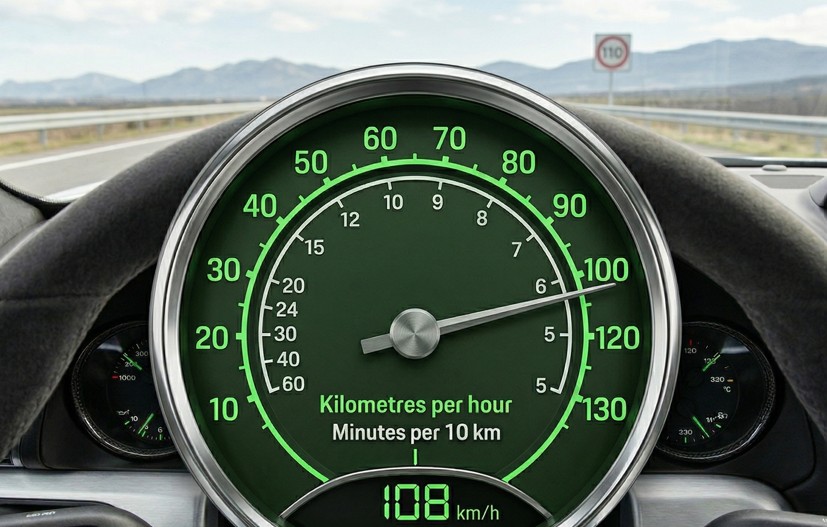
However, increasing from 70 to 80 miles per hour over that same distance only saves about one minute.
Driving at 90 miles per hour instead of 80 creates significant physical risk for everyone on the road.
This behavior puts unnecessary stress on the engine and increases fuel consumption.
Despite the extra effort, the GPS shows a negligible change in the arrival time once the car reaches cruising velocity.
The trade-off between safety and a few saved seconds is mathematically poor.

Road safety experts use these figures to demonstrate that speeding is a psychological urge rather than a logical strategy.
The GPS acts as an objective witness to these physical laws. When you accelerate on a fast road, you work against a scale that yields smaller results.
The GPS reports the facts of the journey without the bias of the person behind the wheel.
Stop chasing the arrival time
The automotive industry is exploring new ways to present this data through the GPS interface.
Future GPS units might include digital tools that show exactly how little time is gained by exceeding the limit.
This feature would provide drivers with the specific second-by-second trade-off of increasing their speed on the highway.
Manufacturers expect that showing this lack of progress will lower accident rates.
A steady arrival time helps maintain a relaxed environment inside the cabin.
Smart cities are also beginning to link with GPS systems to regulate the flow of traffic.
These systems focus on maintaining a consistent speed for all vehicles to prevent the congestion waves caused by sudden braking.
Your arrival time becomes more predictable when the entire road moves as a synchronized unit.
New software updates for your GPS will prioritize these efficiency metrics over the next few years.

Real-time data sharing allows the GPS to select a route based on flow rather than just the shortest physical distance.
Modern drivers must accept that they cannot outrun the clock on a typical trip. Pushing a vehicle to its mechanical limit is unlikely to result in an earlier arrival time on the GPS.
The most effective way to save time is to avoid heavy traffic where average speeds are low.
Once a car reaches highway velocity, the GPS shows that patience is the most efficient tool available.
DISCOVER SBX CARS: The global premium car auction platform powered by Supercar Blondie