Maglev train that once reached 260 mph now sits abandoned, rotting and forgotten in Germany
Published on Apr 01, 2026 at 3:25 PM (UTC+4)
by Molly Davidson
Last updated on Apr 01, 2026 at 11:34 AM (UTC+4)
Edited by
Mason Jones


A maglev train that once reached 260 miles per hour is now sitting abandoned inside a forgotten facility in Germany.
It was built to show what the future of transport could look like without wheels or friction.
For a time, it worked, carrying passengers at speeds most trains still struggle to match.
Now, it’s been left behind in the exact place that was meant to launch it forward.
The maglev train now sitting abandoned inside a forgotten test site
Germany was once leading the charge on maglev technology, developing trains that used magnets to lift above the track and eliminate friction.
That effort became the Transrapid system, tested on a dedicated 20 mile track in Emsland, where the train could reach around 261 miles per hour.
It wasn’t just theoretical either.
Passengers were occasionally allowed on board, turning what started as a test program into something that felt close to real-world use.

But that momentum didn’t last.
In 2006, a test run ended in disaster when the train collided with a maintenance vehicle, killing 23 people and bringing the project to a halt.
From there, things unraveled quickly.
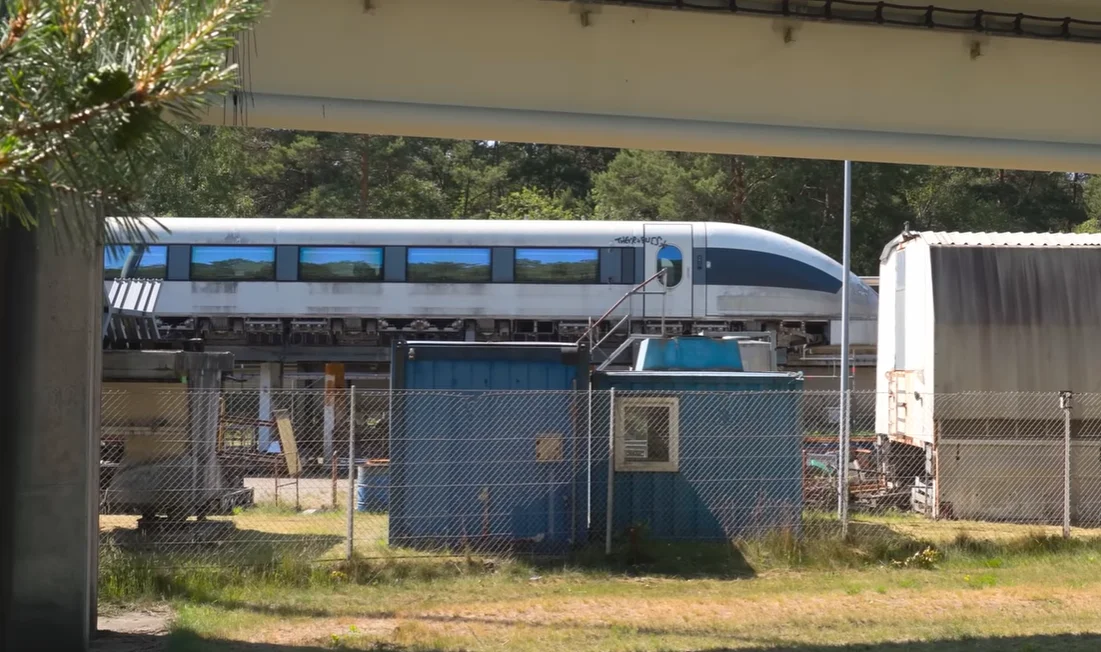
The site shut down in 2011 after Transrapid’s operating license expired, and the entire facility was left behind.
Along with at least one of the trains.
Footage filmed in 2020 by YouTube creator HD1080ide shows the maglev still sitting inside the abandoned site, coated in dust and surrounded by infrastructure that hasn’t been touched in years.

The future didn’t fail, it just moved somewhere else
Germany’s maglev program stalled, but the technology itself didn’t go with it.
Countries like Japan and China continued developing it, pushing speeds even further and turning it into something people use every day.
Japan’s L0 Series has already hit 375 miles per hour in testing, and China operates commercial maglev lines as part of its transport network.
So the idea worked.
Just not here.


That contrast is what the Emsland train has come to represent.
The same technology is still gliding along at full speed in other parts of the world, while this version has been left exactly where development stopped.
Over on Reddit, where people still debate what happened to Transrapid, one user called it ‘a wonderful invention but unfortunately 150 years late’.
Others point out it was never just about speed.
Maglev needed entirely new infrastructure and didn’t slot neatly into existing rail systems, which made it expensive and harder to scale.
Sitting somewhere between high-speed trains and domestic flights, it never really found its place.
So it didn’t disappear because it didn’t work.
It disappeared because it didn’t quite fit.
DISCOVER SBX CARS: The global premium car auction platform powered by Supercar Blondie
With roles at TEXT Journal, Bowen Street Press, Onya Magazine, and Swine Magazine on her CV, Molly joined Supercar Blondie in June 2025 as a Junior Content Writer. Having experience across copyediting, proofreading, reference checking, and production, she brings accuracy, clarity, and audience focus to her stories spanning automotive, tech, and lifestyle news.