People have discovered that if you search '241543903' on Google you get the most bizarre results ever
Published on Feb 17, 2026 at 12:09 PM (UTC-5)
by Daisy Edwards
Last updated on Feb 18, 2026 at 3:33 AM (UTC-5)
Edited by
Emma Matthews
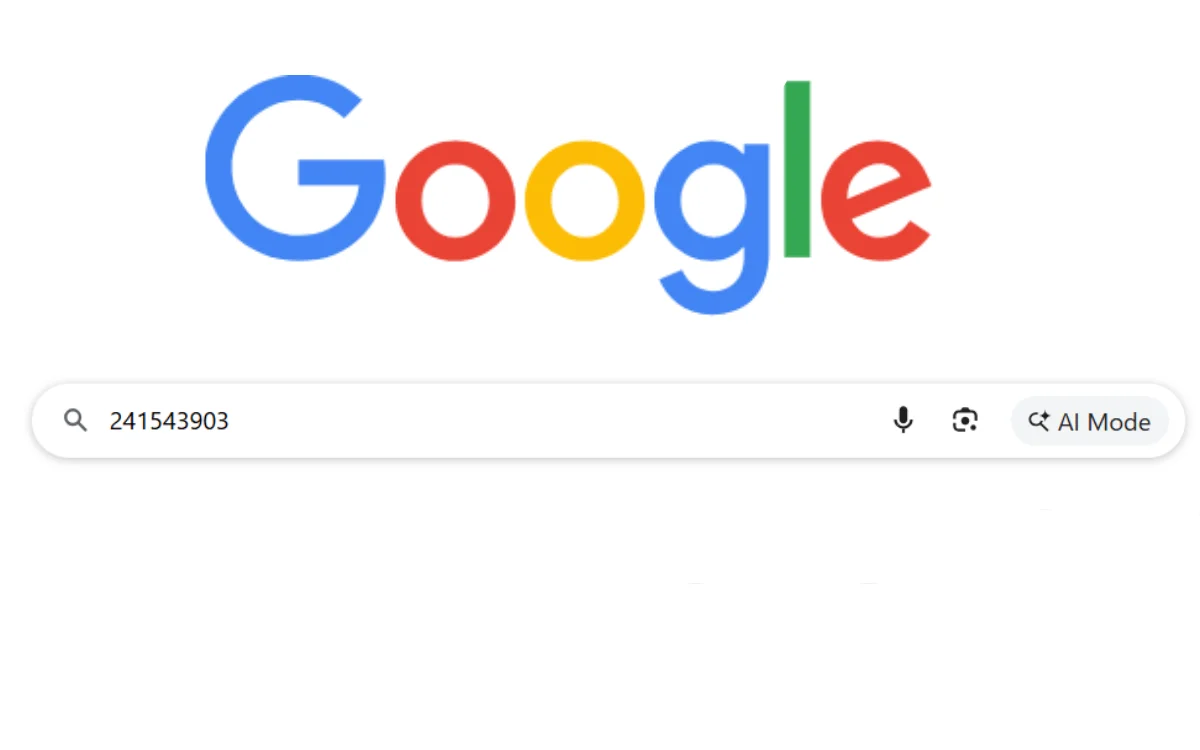

People have discovered that if you search ‘241543903’ on Google, you get the most bizarre results ever because there has been a meme that has quietly been added to since 2009.
At first glance, it looks like someone smashed their keyboard and hit enter.
But type that exact number into Google, head straight to Images, and the results are strange and consistent.
It feels like you have stumbled into a digital cheat code or a glitch that was never meant to be seen.
EXPLORE SBX CARS – Supercar auctions starting soon powered by Supercar Blondie
We bet you’re going to search ‘241543903’ on Google
People have found a strange tech secret when you Google the number ‘241543903’.

The number itself has no obvious meaning, because it is not a famous date or a postcode, nor a well-known error code.
Yet Google treats it as a photo category in the algorithm, and if you scroll long enough, you will notice the same pictures repeating over and over again.
Different homes, countries, and lighting, but the same odd scenario.
Thousands of people have deliberately created near-identical images and tied them all to that one specific number because the internet has quietly agreed on what 241543903 means.
And it has nothing to do with math.
Click the star icon next to supercarblondie.com in Google Search to stay ahead of the curve on the latest and greatest supercars, hypercars, and ground-breaking technology
Search the code for the most bizarre results ever
The explanation dates back to 2009, when New York-based artist David Horvitz uploaded a photo of himself in a very specific pose and tagged it with “241543903.”
He encouraged others to do the same, using that exact number in the title and tags so search engines would link them all together, like a weird Google hack.
The pose was him sticking his head inside a freezer.

That is it, just people opening their freezer compartments and sticking their heads in, then uploading the proof under the same numeric label.
Because enough people followed the instructions, Google’s algorithm learned to associate that random string of digits with one very specific image category.

Over time, ‘241543903’ stopped being a meaningless number and became a reliable way to summon an endless gallery of freezer selfies.
In an internet obsessed with trends and monetization, this one remains beautifully pointless.
It’s not selling anything or promoting a brand; it’s just thousands of strangers agreeing to do something as weird as possible – good old humans.
Daisy is a technology and automotive journalist covering artificial intelligence, consumer tech, Apple news, cryptocurrency, emerging technologies, and transportation innovation. Since joining the team in 2025, she has reported on everything from AI-powered startups and major iOS updates to viral car stories and the latest developments shaping transportation and the digital economy. Drawing on her background in automotive journalism and a degree in History and Journalism from Goldsmiths, University of London, Daisy specializes in breaking down complex topics into clear, engaging reporting for a global audience. Her work spans cutting-edge technology, innovative vehicles, and the people driving change across both industries. Daisy has gained first-hand access to some of the world's most talked-about technologies and innovators, including meeting Tesla's Optimus humanoid robot during its first European appearance in London. She has also discussed the future of space exploration with an astronaut, bringing unique insights and real-world perspectives to her coverage of emerging technology.




