There's a Boeing 747 that has a surreal fifth engine on it and this is why it's vitally important despite bizarre look
Published on Sep 11, 2026 at 4:05 PM (UTC-4)
by Henry Kelsall
Last updated on Sep 16, 2026 at 5:35 AM (UTC-4)
Edited by
Tom Fenton


You might have seen two strange-looking Boeing 747 airplanes with a bizarre fifth engine mounted on top of the fuselage, operated by Pratt & Whitney.
It creates quite a surreal sight, and it almost looks as if it has been left there by mistake and forgotten about.
However, that fifth engine is incredibly important, despite the odd look that it gives the Boeing airliner.
This is because the aircraft is a Boeing 747SP, and there are two of these odd-looking jets still in operation as of September 2026.
Why is there a fifth engine on this Boeing 747?
At the time of writing, just two of these odd-looking ‘Jumbo Jets‘ remain in operation.
These are the Boeing 747SP variants of the jet, and the aircraft are owned by the engine manufacturer Pratt & Whitney.
That fifth engine is mounted on top of the fuselage on an additional mini-wing, just behind the cockpit.
It is a testbed aircraft, used by Pratt & Whitney to test conceptual engine designs before they enter full production.

Interestingly, the SPs are the smallest versions of the 747 ever produced.
Each gathers real-world flight data during test flights, and they push the extra engine to its limits.
Engines must be able to survive in various uncontrollable conditions, such as extreme temperatures and weather.
“These are things that are very difficult or impossible to do on the ground,” said a General Electric test pilot.
Related

Inside the aircraft is also incredibly different
It isn’t just the outside that is different on these aircraft.
Inside, the 747s do not have the regular three-class layout you’d find on most commercial aircraft.
The space is instead taken up by Pratt & Whitney for various workstations.
Flight engineers man each of these stations, with each one measuring different aspects of the fifth engine.
They can also configure the engine to operate in different ways to really test it out.

Each test can take up to eight hours to complete, as if it were a commercial flight.
Before the acquisition of the 747SPs, the company would simply swap one of the four engines on a Boeing 747.
Another method was to mount the engine under the aircraft in a ‘pod’ position.
There are other testbed aircraft in operation
The aformentioned Boeing 747s are not the only testbed aircraft used in this manner.
General Electric also uses a Boeing 747 for tests.
Rolls-Royce did the same, retiring its own testbed 747-200 airliner in 2025.
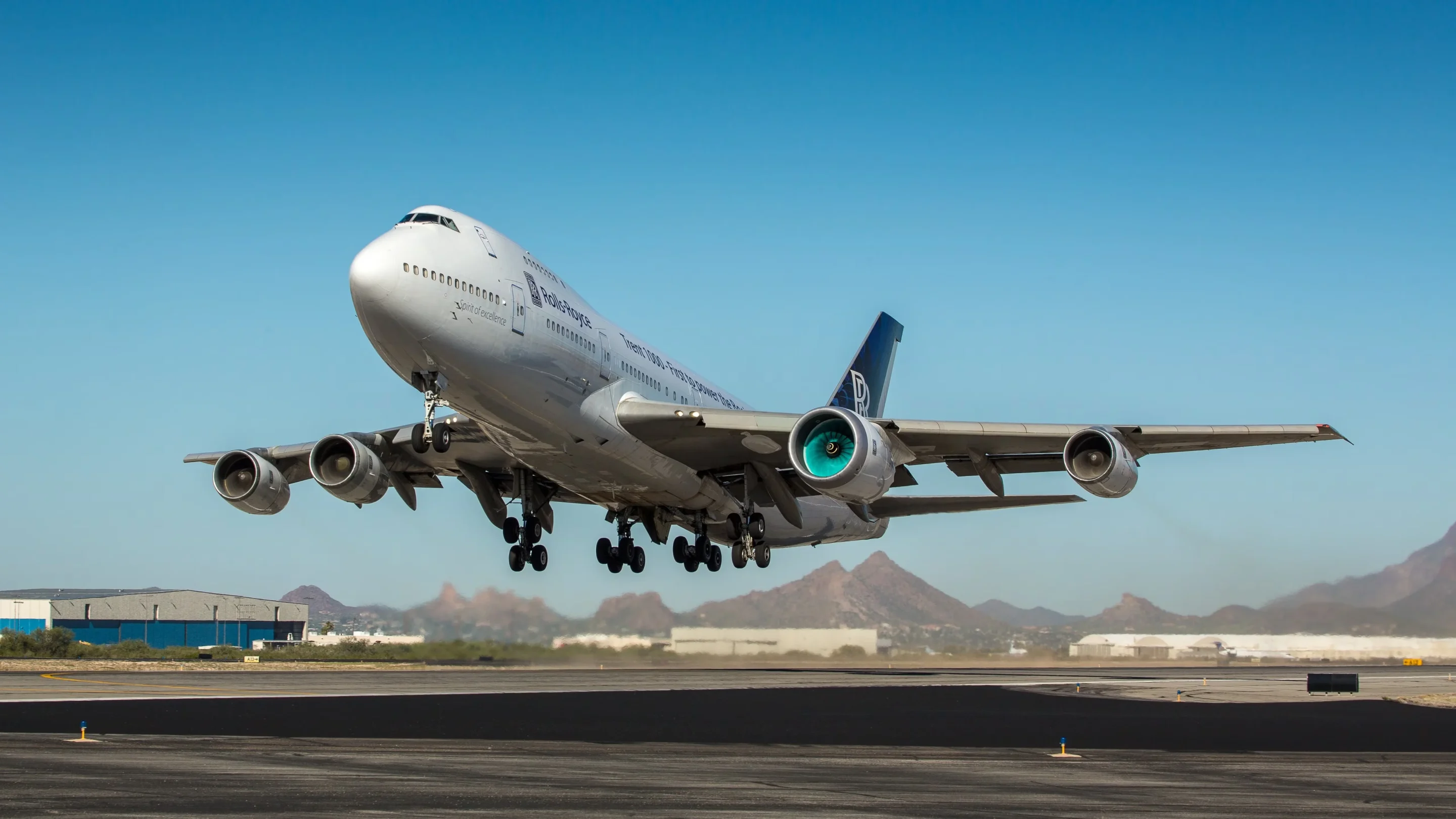
Other aircraft, such as the Boeing 757-200, have also flown with an additional engine.
Out of all of them, though, the Pratt & Whitney Boeing 747SPs are perhaps the most striking to look at.
Their visible shortness compared to a standard ‘Jumbo Jet’, along with the fifth engine, creates a unique look.
They are also rare aircraft, as Boeing only made 45 SP versions of its famous airliner.
Henry joined the Supercar Blondie team in February 2025, and since then has covered a wide array of topics ranging from EVs, American barn finds, and the odd Cold War jet. He’s combined his passion for cars with his keen interest in motorsport and his side hustle as a volunteer steam locomotive fireman at a heritage steam railway.