Boeing pilot shows the last line of defense when planes come dangerously close
Published on Jan 08, 2026 at 5:30 AM (UTC+4)
by Keelin McNamara
Last updated on Jan 07, 2026 at 7:31 PM (UTC+4)
Edited by
Amelia Jean Hershman-Jones
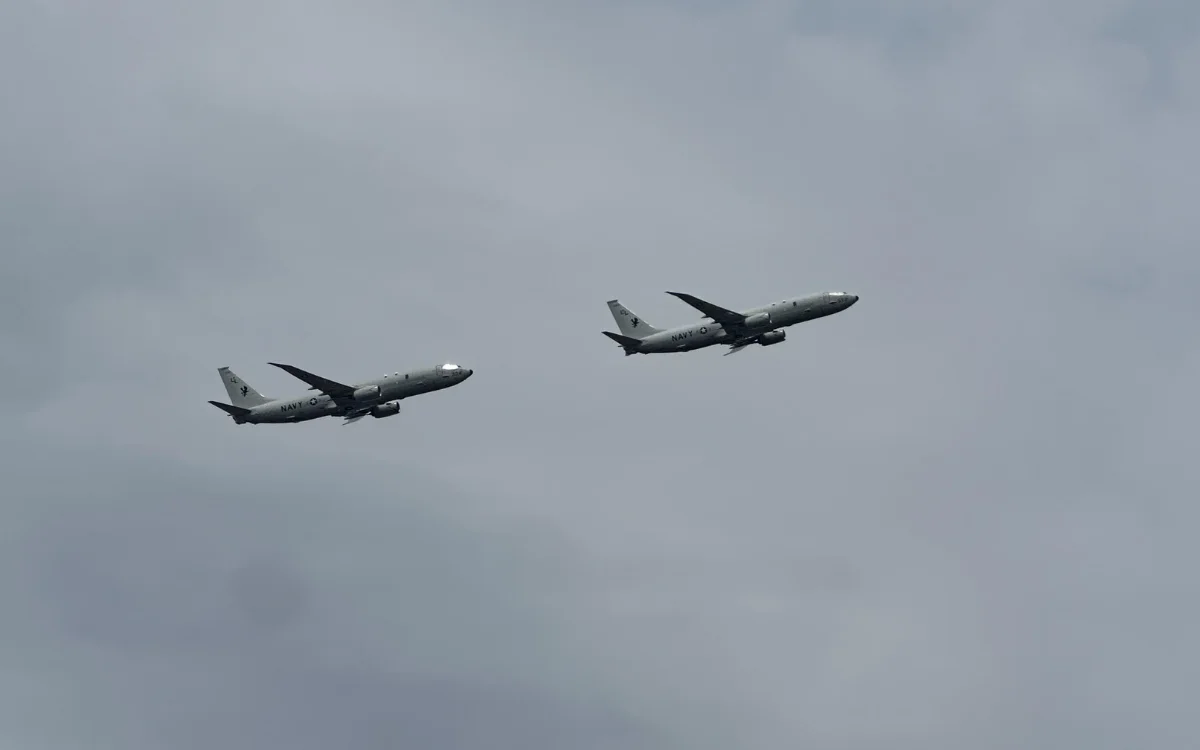

While airplanes appear much closer from the ground than they are in reality, a Boeing pilot has just shown the last line of defense when planes come dangerously close.
And it is all thanks to an incredibly important piece of safety software.
The TCAS (Traffic Collision Avoidance System) is aviation’s last line of defense.
And it is an extremely clever piece of technology.
DISCOVER SBX CARS: The global premium car auction platform powered by Supercar Blondie
Boeing pilot showcases amazing technology
Have you ever wondered what happens when two airplanes get dangerously close?
Well, the answer is here – and it comes courtesy of a Boeing pilot.
The Boeing pilot in question is pilot_obet on Instagram.
And his video showcases an incredible piece of technology called the TCAS (Traffic Collision Avoidance System).
But what exactly is the TCAS – and what does it do?
The TCAS is an industry-wide, independent last line of defense against mid-air collisions.
And it works without having to rely on ground radar or air traffic control (ATC).
Instead, it works by constantly monitoring nearby aircraft transponders.
It does so in order to calculate relative position, altitude, and closing trends in real time.
When a potential problem arises, TCAS kicks into action.
It first issues a Traffic Advisory (TA) to alert pilots to be very cautious of outside conditions.
Should the situation get worse, the TCAS then escalates and issues a Resolution Advisory (RA).
This provides clear instructions to the pilot, such as to climb or descend.
But the system is even smarter than you think.
TCAS can communicate with both aircraft
If both aircraft are TCAS-equipped, both systems will work to provide complementary advice to both aircraft.
This avoids both aircraft ascending or descending and colliding with each other.
Pilots are constantly trained to follow an RA immediately.
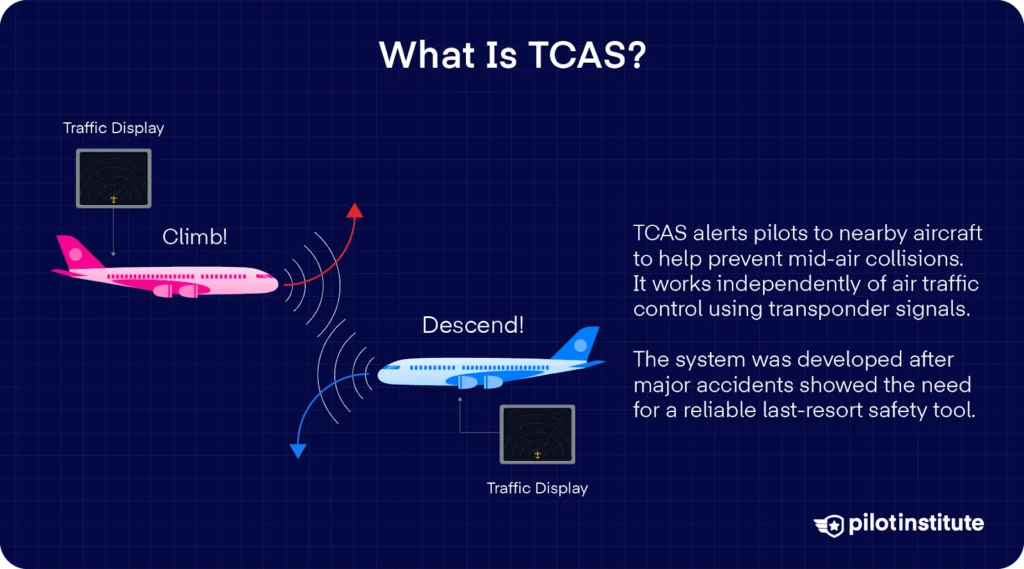
An RA is so important that it even overrides ATC instructions.
Pilots will then inform ATC once the situation has been resolved in mid-air.
Crews are also able to attempt increasing exterior lighting in order to see and be seen.
But TCAS remains the absolute primary source of guidance.
It really is such a fascinating piece of technology – and one that keeps millions safe.