Data scientist reveals optimal road trip across the US with goal to find most efficient route and it's eye-opening to see
Published on Apr 06, 2026 at 8:26 AM (UTC+4)
by Callum Tokody
Last updated on Apr 02, 2026 at 2:09 PM (UTC+4)
Edited by
Emma Matthews

A data scientist recently used genetic algorithms to solve the ultimate road trip by mapping the most efficient route through 50 major landmarks.
Dr. Randal Olson utilized a custom Python script to calculate the precise driving distances between thousands of potential stop-off points.
The resulting itinerary spans 13,699 miles and ensures that travelers touch every state in the contiguous United States without backtracking.
This mathematical breakthrough suggests that even the most sprawling cross-country trek can be tamed into a single, perfect loop if you know where to look.
Click the star icon next to supercarblondie.com in Google Search to stay ahead of the curve on the latest and greatest supercars, hypercars, and ground-breaking technology
Solving the 13,699-mile road trip puzzle
The planning process for this road trip relied on solving the Traveling Salesman Problem, which is a classic puzzle in optimization.
Traditional computers would require billions of years to test every possible sequence for 50 different stops.
Olson bypassed this limitation by using genetic algorithms to find a near-perfect solution in less than a minute.
This method starts with random paths and continually refines them until the most efficient route remains.
The final path includes major landmarks such as the Grand Canyon, the Statue of Liberty, and the Gateway Arch.
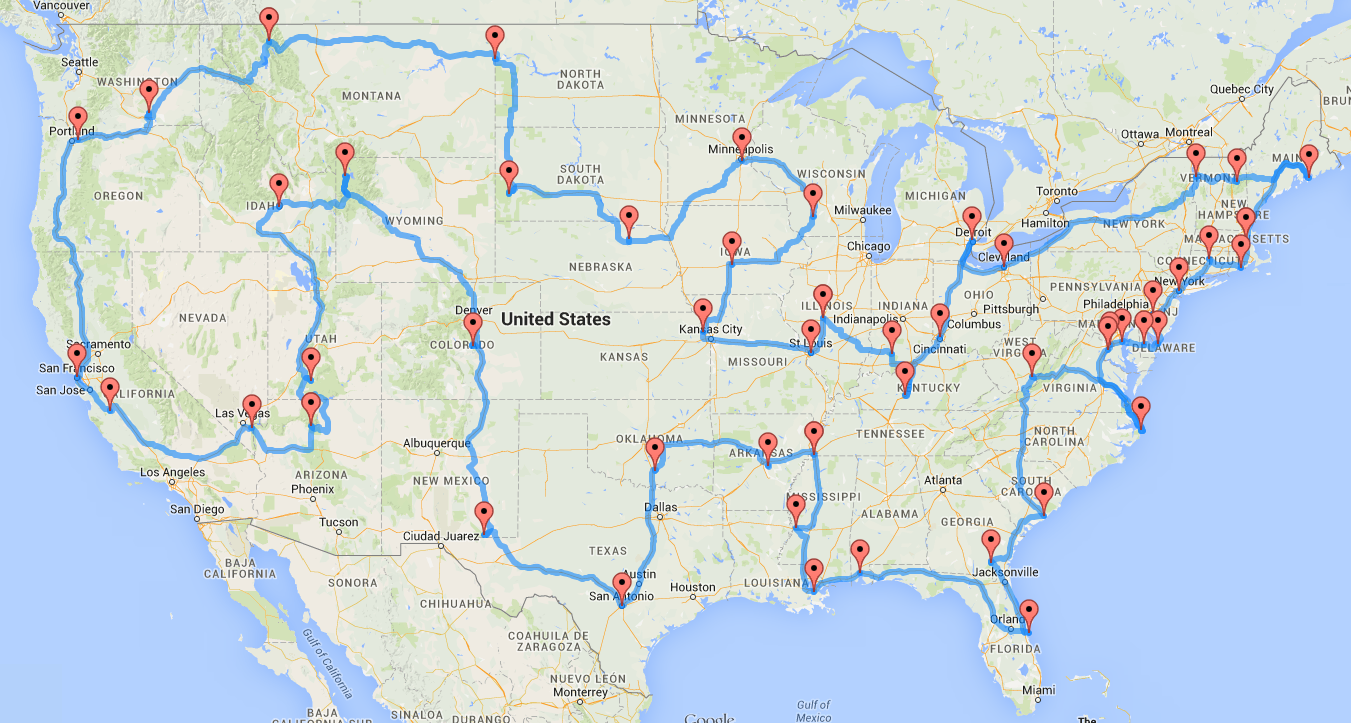
Each stop on this road trip represents a significant National Park, National Monument, or National Historic Site, and the total driving time equals approximately 224 hours of pure transit.
But the researcher suggested a two-month timeframe for the actual sightseeing.
Following this efficient route allows a driver to start at any of the 50 major landmarks and complete the loop in the same order.
This level of precision eliminates the logistical guesswork that usually defines transcontinental travel.
The data confirms that an optimized road trip saves hundreds of hours of redundant driving across state lines.
Algorithms replace the paper map
The application of genetic algorithms to travel logistics suggests a shift in how long-distance journeys are organized.
Beyond historical sites, this technology can map a road trip based on popular cities or specific commercial hubs.
Having found this incredible solution, Olson then developed a secondary efficient route for road-trippers who prefer urban environments to more rural areas.
This alternative focused on top-rated destinations from TripAdvisor.
These models prove that complex data sets can simplify personal travel by identifying the most direct path between multiple interests.
Future software will likely incorporate real-time variables like road closures or seasonal traffic into these genetic algorithms.
A road trip of this magnitude – crossing the entire United States – is no longer a logistical nightmare thanks to advanced data modeling.
High-resolution mapping and algorithmic sorting have turned a 13,699-mile journey into a manageable checklist for any motivated driver.
DISCOVER SBX CARS: The global premium car auction platform powered by Supercar Blondie