The hidden complexity of F1 steering wheels and what drivers really do behind the wheel
- Mercedes-AMG has demystified the F1 steering wheel
- There are 15 buttons and countless different settings
- It reveals the complicated job F1 drivers really have
Published on Mar 23, 2025 at 7:08 AM (UTC-4)
by Daisy Edwards
Last updated on Mar 23, 2025 at 7:08 AM (UTC-4)
Edited by
Kate Bain
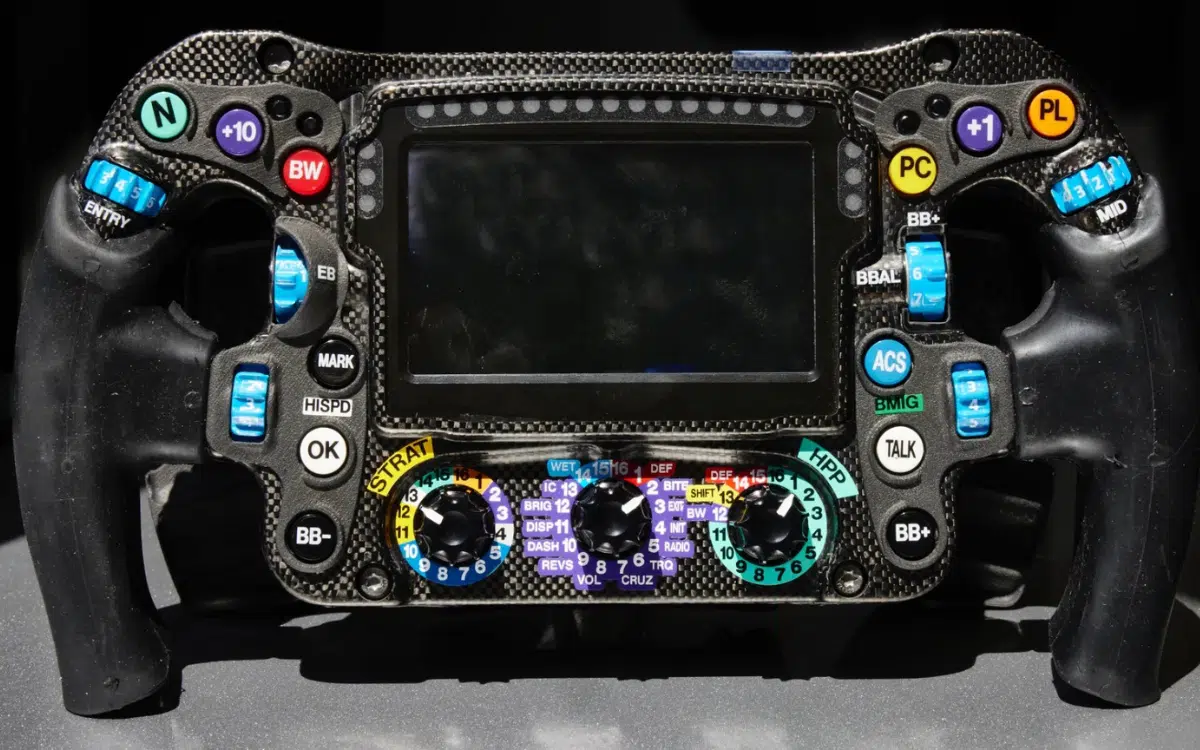

The Mercedes-AMG Petronas Formula One Team has released a video that reveals exactly what F1 drivers have to do behind the wheel – and it’s complicated.
On TV you often only get to see the back of the wheel when they are filming drivers’ faces so the complex interface of the steering wheel often goes unnoticed.
It actually looks like a handheld gaming device – there are paddles, speed inhibitors, buttons to alert the pit crew, and even ways to alert data points of interest for the driver.
Now the secrets of the steering wheel have been revealed and it shows just how much F1 drivers have to think about while trying to win a race.
EXPLORE SBX CARS – Supercar auctions starting soon powered by Supercar Blondie
The secrets of the F1 steering wheel
Finally F1 fans have an answer to the question: what do all those buttons do?
The Mercedes AMG Formula One Team revealed in a video what the F1 drivers are looking at on their steering wheels when they’re driving.
The F1 steering wheel has 15 different buttons, knobs, paddles, and settings for the drivers to take into account while they’re racing.
So here’s a breakdown of the elements.
The steering wheel is where you control the strategy settings of your racecar.
Strategy settings help when it’s wet on the track or you suddenly get a puncture in your tire.
You can change your racecar’s power settings using the ‘MGU-K Settings’ function.

Like all pieces of tech, the steering wheel has a ‘Menu’ and ‘Accept’ button for ease of use.
There’s also a ‘Mark’ feature which means that the driver can use it to mark the car’s telemetry points at specific times of interest, so they can discuss it later.
The Differential and Brake Balance settings can be controlled using scroll knobs.
Using a feature called ‘Energy Recovery’ means that you can recover energy you made during braking and save it for later when you really need it.
Speed-wise, you can select a button that limits entry into the pit-lane, as well as set a race start speed, too.
The Neutral button might be the only relatable function on an F1 steering wheel, so there’s not much to explain on that one.
They can even press a button to have a drink
The steering wheel has a few buttons for communication, like ‘Pit Confirm,’ which is how you would tell your team that you heard them loud and clear and you’re coming into the pit.
The steering wheel also houses a ‘drink’ button, which prompts a hydration pack to empty directly into a driver’s mouth.
There’s also ‘Overtake’ which gives you a short boost so you can, you guessed it, overtake someone and ‘DRS’ which stands for Drag Reduction System, when you hit this button, the rear wing opens slightly, reducing drag.
Each driver’s steering wheel is modelled to their hands, so expect your steering wheel to be one of a kind.
There’s paddles on the steering wheel that you can set up to suit your own personal preferences, as well as a ‘Quick Release Hub’ which allows for a quick entry or exit in the case of an emergency.
So, there you have it, you’re all set up for your first day on the F1 racetrack, good luck!
Daisy is a technology and automotive journalist covering artificial intelligence, consumer tech, Apple news, cryptocurrency, emerging technologies, and transportation innovation. Since joining the team in 2025, she has reported on everything from AI-powered startups and major iOS updates to viral car stories and the latest developments shaping transportation and the digital economy. Drawing on her background in automotive journalism and a degree in History and Journalism from Goldsmiths, University of London, Daisy specializes in breaking down complex topics into clear, engaging reporting for a global audience. Her work spans cutting-edge technology, innovative vehicles, and the people driving change across both industries. Daisy has gained first-hand access to some of the world's most talked-about technologies and innovators, including meeting Tesla's Optimus humanoid robot during its first European appearance in London. She has also discussed the future of space exploration with an astronaut, bringing unique insights and real-world perspectives to her coverage of emerging technology.




