Underwater robots have been diving to France's deepest shipwreck and discovering some incredible things at the 16th century vessel
Published on May 12, 2026 at 6:06 PM (UTC-4)
by Daisy Edwards
Last updated on May 12, 2026 at 6:06 PM (UTC-4)
Edited by
Mason Jones
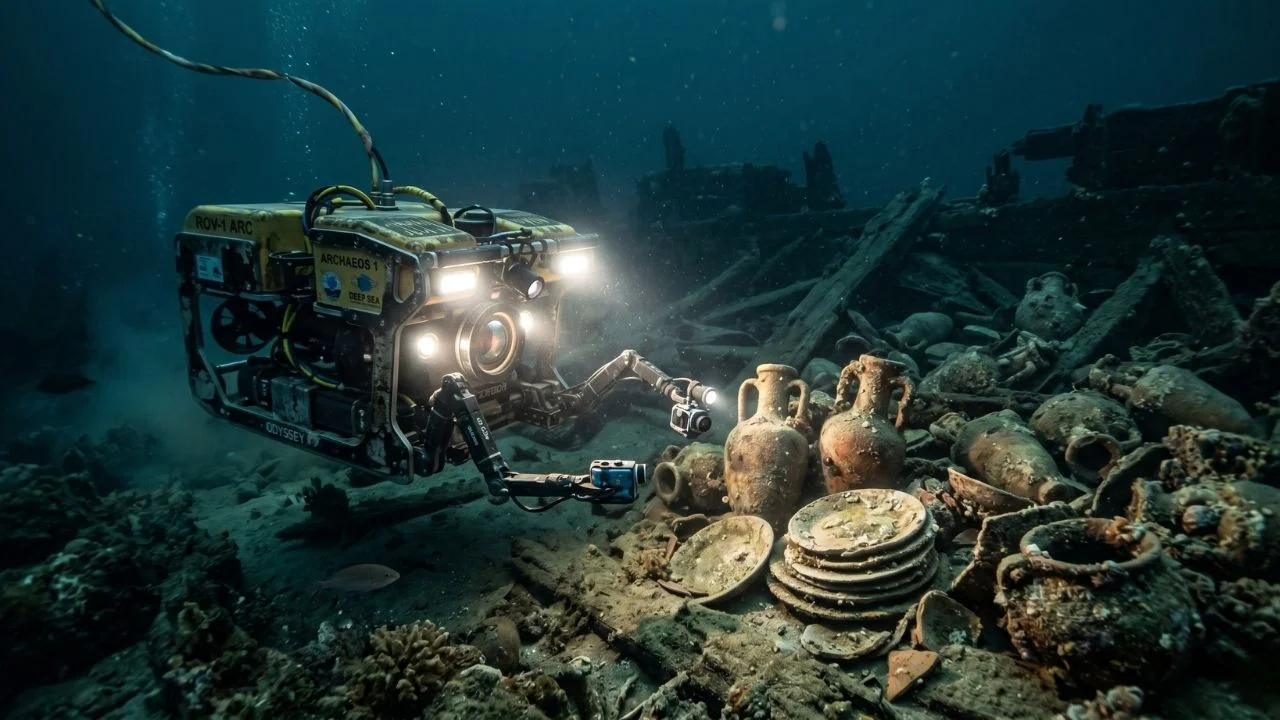

A team of underwater robots has been sent deep beneath the Mediterranean Sea to explore France’s deepest shipwreck, and honestly, it sounds like something straight out of an adventure movie.
The wreck, known as the Camarat 4, has been sitting untouched at the bottom of the sea since the 16th century after it mysteriously sank hundreds of years ago.
Now, high-tech robots are finally giving archaeologists a close-up look at the lost vessel and uncovering incredible treasures that have somehow survived for centuries.
From ancient pottery to cannons and even perfectly preserved plates, the ship has basically become a giant underwater time capsule.
What’s inside France’s deepest shipwreck
The shipwreck was discovered off the coast near Saint-Tropez after high-tech sonar scans picked up the outline of a massive vessel deep on the seabed.
Researchers later confirmed it was a 16th century merchant ship measuring nearly 100 feet long, making it one of the most fascinating underwater discoveries France has ever seen.
To investigate it properly, archaeologists sent down a remotely operated underwater robot that took around an hour just to reach the wreck.

Once it finally arrived, the robot captured nearly 67,000 images of the site so experts could create a full 3D model of the ship.
And the things sitting down there are incredible.
The vessel appears to have been carrying hundreds of ceramic jugs, bowls, and plates from Italy, many of which are still amazingly intact despite being underwater for hundreds of years.
Some even feature ancient religious markings and decorative designs that are still clearly visible today.
Researchers also spotted six cannons, huge anchors, iron bars, and giant cooking pots scattered around the wreck like the crew had only just left.

Related


The 16th century vessel became a real-life underwater time capsule
Because the wreck sits more than 1.5 miles underwater, it has stayed surprisingly well-preserved for centuries.
The extreme depth protected it from storms, strong currents, and treasure hunters, leaving many of the objects almost perfectly frozen in time.
Archaeologists recently recovered a handful of artifacts from the site, including decorative ceramic pitchers and a beautifully painted plate with blue and yellow patterns.
Experts say some of these are now among the deepest artifacts ever recovered from a French shipwreck.

The whole discovery is giving historians a rare glimpse into what Mediterranean trade looked like during the 1500s, including what merchants transported across Europe hundreds of years ago.
But while the ancient objects survived the centuries, there was one modern discovery researchers definitely weren’t expecting.

Alongside the centuries-old treasures, the underwater robots also found plastic bottles, fishing nets, yogurt containers, and beer cans littering the ocean floor around the wreck.
So, even one of the deepest shipwrecks in France still couldn’t escape modern trash.
Daisy is a technology and automotive journalist covering artificial intelligence, consumer tech, Apple news, cryptocurrency, emerging technologies, and transportation innovation. Since joining the team in 2025, she has reported on everything from AI-powered startups and major iOS updates to viral car stories and the latest developments shaping transportation and the digital economy. Drawing on her background in automotive journalism and a degree in History and Journalism from Goldsmiths, University of London, Daisy specializes in breaking down complex topics into clear, engaging reporting for a global audience. Her work spans cutting-edge technology, innovative vehicles, and the people driving change across both industries. Daisy has gained first-hand access to some of the world's most talked-about technologies and innovators, including meeting Tesla's Optimus humanoid robot during its first European appearance in London. She has also discussed the future of space exploration with an astronaut, bringing unique insights and real-world perspectives to her coverage of emerging technology.




