November 2026 will mark the first time in history a human-made object has travelled a light day away from Earth
Published on Jun 29, 2025 at 6:04 PM (UTC-4)
by Daisy Edwards
Last updated on Jun 29, 2025 at 6:04 PM (UTC-4)
Edited by
Kate Bain
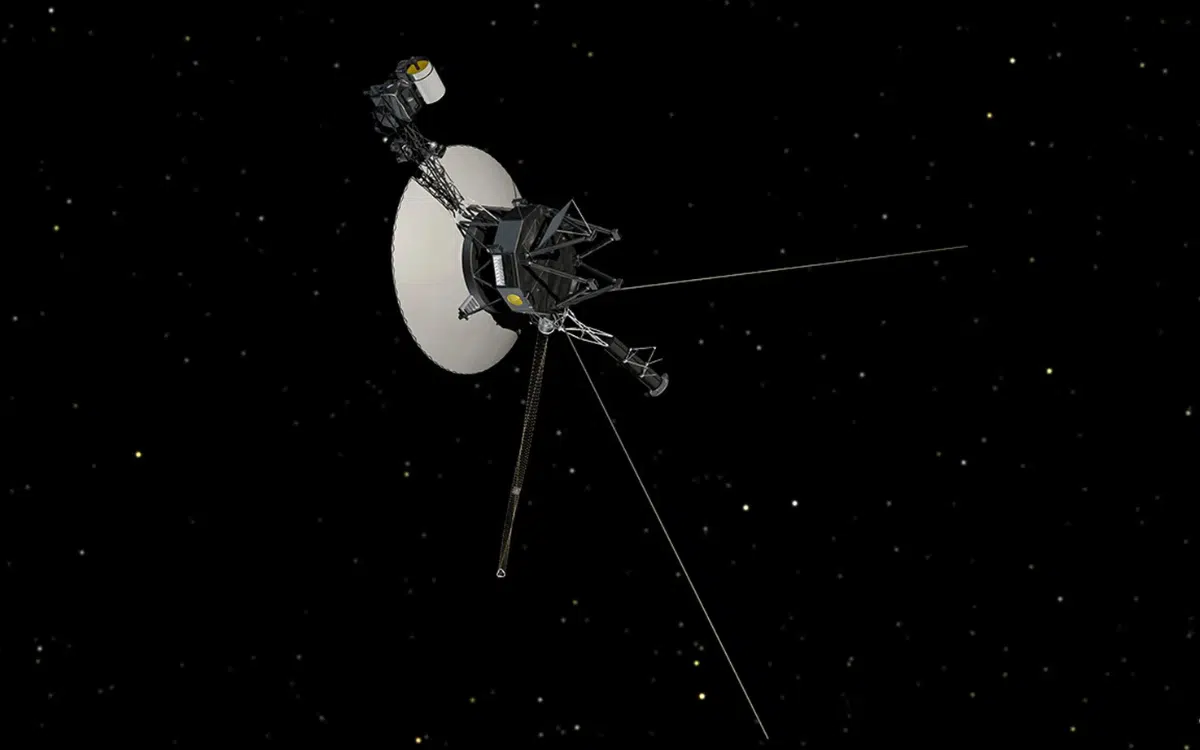

November 2026 will mark the first time in history a human-made object has travelled a light day away from Earth and it’s a scary reminder of just how vast space is.
A spacecraft called Voyager 1 was launched all the way back in 1977 and has been travelling through space ever since.
Voyager 1 is actually only 166 Astronomical Units away from earth, but it’s still going to be over a whole Earth year before it’s one light-day away from us.
A light-day counts as when it takes 24 hours for light to travel from Earth to the object, and Voyager 1 has almost made it far enough away. It’s only taken 50 years!
EXPLORE SBX CARS – Supercar auctions starting soon powered by Supercar Blondie
First human-made object a light day away from Earth
As Douglas Adams wrote in The Hitchhiker’s Guide to the Galaxy, “Space is big. Really big,” and this revelation about the 70s spacecraft Voyager 1 is a stark reminder of that.
Now while space is humungous, human-made objects are also not great at being very fast, the fastest spaceflight by humans was Apollo 10 back in 1969.
In 1977, a spaceship called Voyager 1 was launched into space and it has been travelling through space ever since, it was the first spacecraft to go beyond the heliosphere and enter interstellar space.
It would take 23 hours, 5 minutes and 36 seconds for light and communication signals from earth to reach Voyager 1 at its current position, but when it takes 24 hours to reach the spacecraft, that means it’s a light day away.


November 2026 is only a light-day away
While it is still over one earth year away, November 2026 marks the moment that Voyager 1 will be one official light-day away from earth, and by January 2027, it will be a light day from the sun.
Turns out that in the grand scheme of things, light-time-wise, the sun is not actually that far away from the Earth.
Trying to understand the vastness of space seems almost impossible, but the fact that it will take almost 50 years for a spacecraft to only travel one light-day away is truly mind-bending.
If NASA wants to send Voyager 1 a happy 50th birthday message, the scientists will have to remember to send it a day in advance just so it gets there in time.
Daisy is a technology and automotive journalist covering artificial intelligence, consumer tech, Apple news, cryptocurrency, emerging technologies, and transportation innovation. Since joining the team in 2025, she has reported on everything from AI-powered startups and major iOS updates to viral car stories and the latest developments shaping transportation and the digital economy. Drawing on her background in automotive journalism and a degree in History and Journalism from Goldsmiths, University of London, Daisy specializes in breaking down complex topics into clear, engaging reporting for a global audience. Her work spans cutting-edge technology, innovative vehicles, and the people driving change across both industries. Daisy has gained first-hand access to some of the world's most talked-about technologies and innovators, including meeting Tesla's Optimus humanoid robot during its first European appearance in London. She has also discussed the future of space exploration with an astronaut, bringing unique insights and real-world perspectives to her coverage of emerging technology.




