This is what the probes on the nose of an Airbus A350 do
Published on Jan 10, 2026 at 10:37 PM (UTC+4)
by Molly Davidson
Last updated on Jan 09, 2026 at 7:33 PM (UTC+4)
Edited by
Molly Davidson

If you’ve ever zoomed in on the nose of an Airbus A350, you’ve probably noticed the little metal probes sticking out.
They’re easy to miss at first, but once you see them, you can’t unsee them.
Naturally, people start wondering what each one does and whether they’re all there for the same reason.
As it turns out, they’re some of the hardest-working parts of the aircraft.
DISCOVER SBX CARS – The global premium auction platform powered by Supercar Blondie
Why the Airbus A350 has probes on its nose
Most of what’s mounted on the A350’s nose exists for one core job: reading the air the aircraft is flying through.
The probes on either side are known as Multi-Function Probes, or MFPs.
Rather than scattering individual sensors around the fuselage, Airbus grouped several measurements into these units.
They handle airspeed, altitude, and how the airflow meets the aircraft – data that feeds directly into the flight computers and cockpit displays.

One of the most important inputs here is angle of attack.
That’s the relationship between the wing and the oncoming air, and it plays a huge role in keeping the aircraft safely within its performance limits.
Especially during takeoff and landing.
Some A350s also have three small probes mounted on top of the nose.
These are Side Slip Angle sensors.
Their job is to detect when the aircraft isn’t moving perfectly straight through the air – something that can happen during crosswinds, turns, or turbulent conditions.
Why newer A350s look cleaner up front
When the A350 was first introduced, Airbus believed it could calculate side slip accurately using software alone.
But before relying on that fully, engineers wanted real-world confirmation.
So early production aircraft were fitted with physical Side Slip Angle probes to verify the data during everyday airline operations.
Once enough flight data was gathered, the conclusion was clear: the software was doing the job just fine.
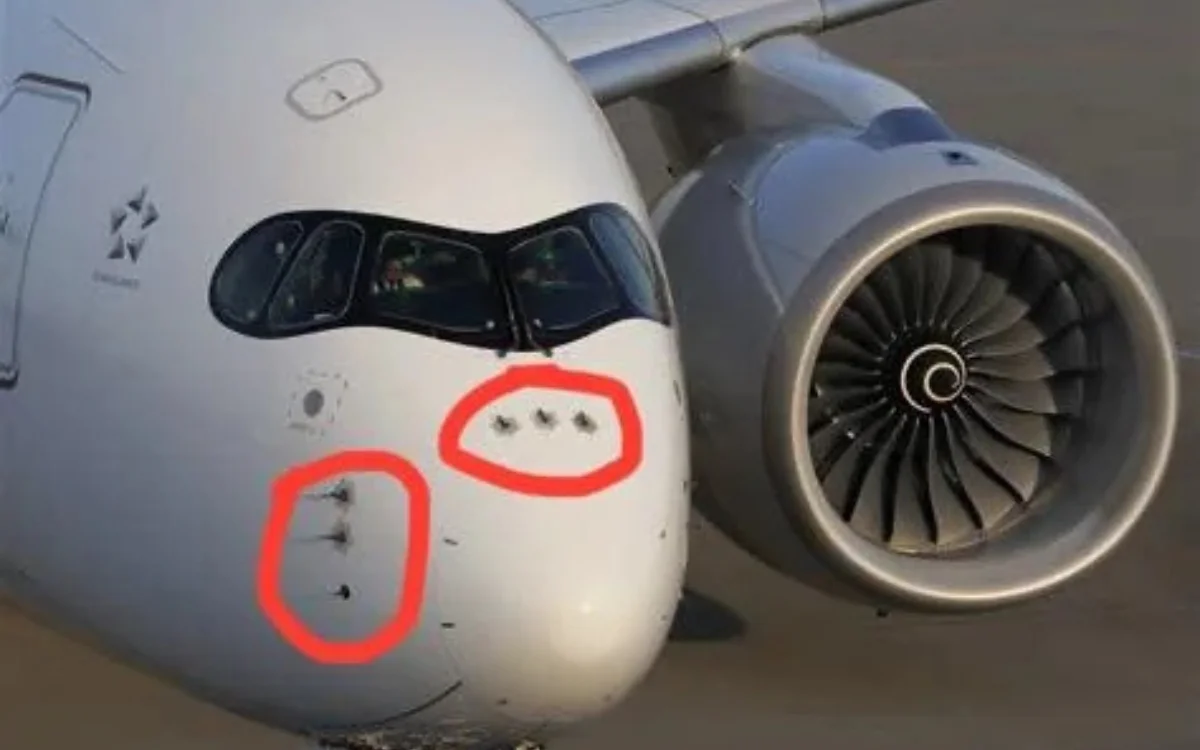
That’s why newer A350s no longer carry those top-mounted probes, and why older aircraft will have them removed during scheduled maintenance.
Fewer external sensors mean less drag, less maintenance, and small fuel savings that add up over time.
So if you spot an A350 with extra spikes on its nose, you’re likely looking at an early-production aircraft that still has its original test hardware fitted.
And next time you’re boarding one, you’ll know exactly why that nose looks the way it does.
DISCOVER SBX CARS: The global premium car auction platform powered by Supercar Blondie
With roles at TEXT Journal, Bowen Street Press, Onya Magazine, and Swine Magazine on her CV, Molly joined Supercar Blondie in June 2025 as a Junior Content Writer. Having experience across copyediting, proofreading, reference checking, and production, she brings accuracy, clarity, and audience focus to her stories spanning automotive, tech, and lifestyle news.