Ford used 3D printing at Nürburgring to shave five seconds off Mustang GTD lap time
Published on Dec 25, 2025 at 10:47 AM (UTC+4)
by Keelin McNamara
Last updated on Dec 09, 2025 at 4:54 PM (UTC+4)
Edited by
Emma Matthews

Ford has used 3D printing at the Nürburgring to shave five seconds off the Mustang GTD lap time.
The Ford Mustang GTD represents a new age for American performance on the track.
Unlike previous attempts, this is a serious step up in competition with its European rivals.
And the Blue Oval used a tiny, 3D-printed part to knock five seconds off its lap time.
DISCOVER SBX CARS: The global premium car auction platform powered by Supercar Blondie
Ford Mustang GTD storms around Nurburgring…
The brand-new Ford Mustang GTD is a seriously impressive piece of track-focused weaponry.
It has been lauded as representing a massive evolution in the American approach to performance.
Historically, offerings from Detroit have always been extraordinarily powerful in a straight line.
But these cars have historically always been let down in pretty much every other area.
This new Mustang GTD, though, has completely shattered that historic trend.

A strenuous focus on aerodynamics and cornering has made the Mustang GTD a true supercar force to behold.
Nowhere was this more clear and obvious than during a testing event at Germany’s Nürburgring in April of this year.
The Blue Oval brand’s offering managed to set an unreal lap time of 6:52.072s.
Smashing the seven-minute barrier makes the Ford Mustang GTD a serious contender.
In case you were wondering – that makes the Ford Mustang GTD faster than any Ferrari around the same track.
The Ferrari 296 GTB is the closest rival, but it is an unbelievable six seconds slower than its American counterpart.
…And it is all thanks to 3D printing
Right now, you might be asking – how on Earth did Ford manage to achieve this?
Well, as it turns out, the brand actually turned to a 3D-printed part to put it over the edge.
As you know by now, the new Mustang GTD carries some serious aero development.
An active drag-reduction system is partnered with a carbon-fiber swan neck wing.
But, during the Nürburgring test, Ford engineers realized that they were missing something.
The muscle car required much more downforce in order to fully utilize its power.
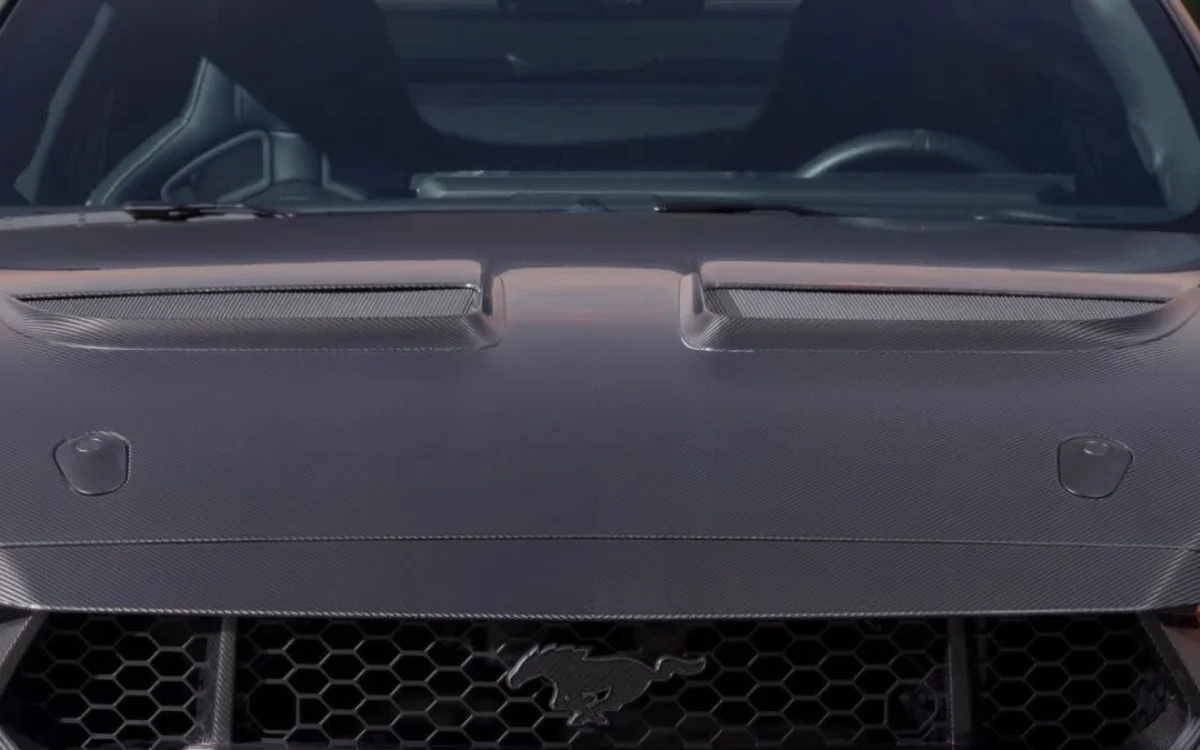
It turns out that the breakthrough came with tiny, 3D-printed ‘hood flicks.’
These raised pieces are placed around the hood vents to ever-so-slightly reshape the airflow.
They ultimately added much more front-end bite while keeping the drag coefficient unchanged.
It turns out that millions of dollars in R&D funds can be saved simply by using a 3D printer.