Man who spent 200 days building a solar-powered explorer yacht that can run forever shares how much solar he'd need to cruise at 6.5 knots
Published on Mar 29, 2026 at 12:47 AM (UTC+4)
by Callum Tokody
Last updated on Mar 26, 2026 at 7:44 PM (UTC+4)
Edited by
Emma Matthews

The solar-powered Helios 11 superyacht utilizes high-efficiency solar panels to maintain a consistent cruise speed without the need for filling up.
This yacht took 200 days of focused construction to achieve this total energy autonomy for ocean travel.
Currently operating on the Euron River in France, the prototype serves as a practical test for renewable propulsion in real-world conditions.
Staying afloat on this boat very much depends on the specific math that dictates exactly how far it can go on daylight alone.
Enter our competition to win a stunning 2006 Ford GT or $400,000 cash!
The math behind infinite solar-powered range
The Helios 11 carries a raw solar capacity of 6,200W generated by its array of solar panels.
This set-up produces approximately 2,000W of energy on an average day, which powers the electric motor directly.
Even under heavy cloud cover, the solar-powered boat harvests enough light to keep the essential onboard systems active.
Rainy conditions still yield up to 800W for the battery bank, which provides a baseline for the Helios 11.
During construction, the shipbuilder worked out that 6,000W of solar panels was exactly what this yacht needed to keep sailing.
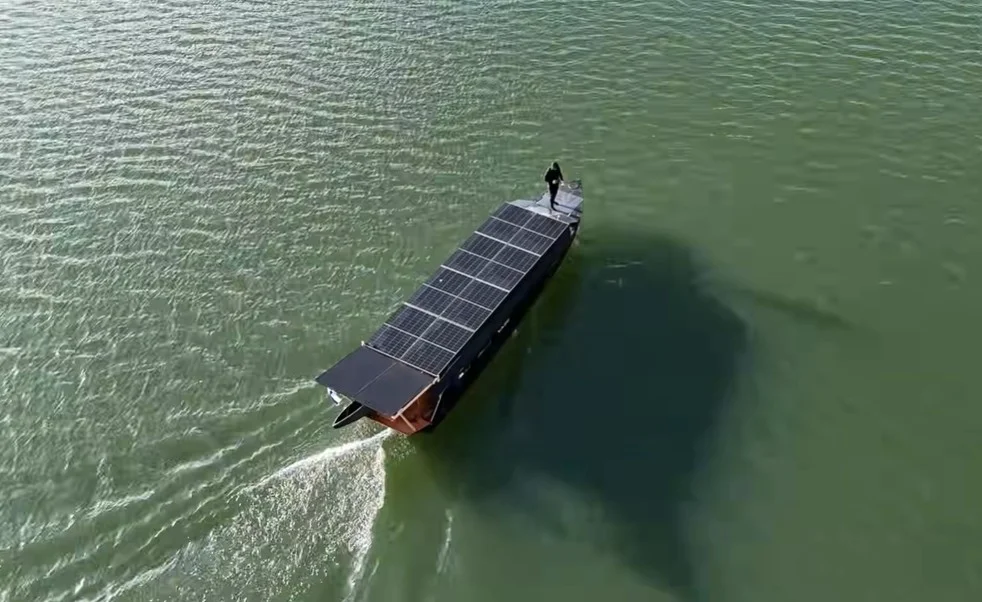
At this power level, the Helios 11 maintains a steady cruise speed of six to seven knots during daylight hours, but if you reduce that pace to four knots, the yacht can go on forever, in theory.
This state allows the batteries to remain at full charge while the motor runs exclusively on solar-powered energy, which is an incredible feat.
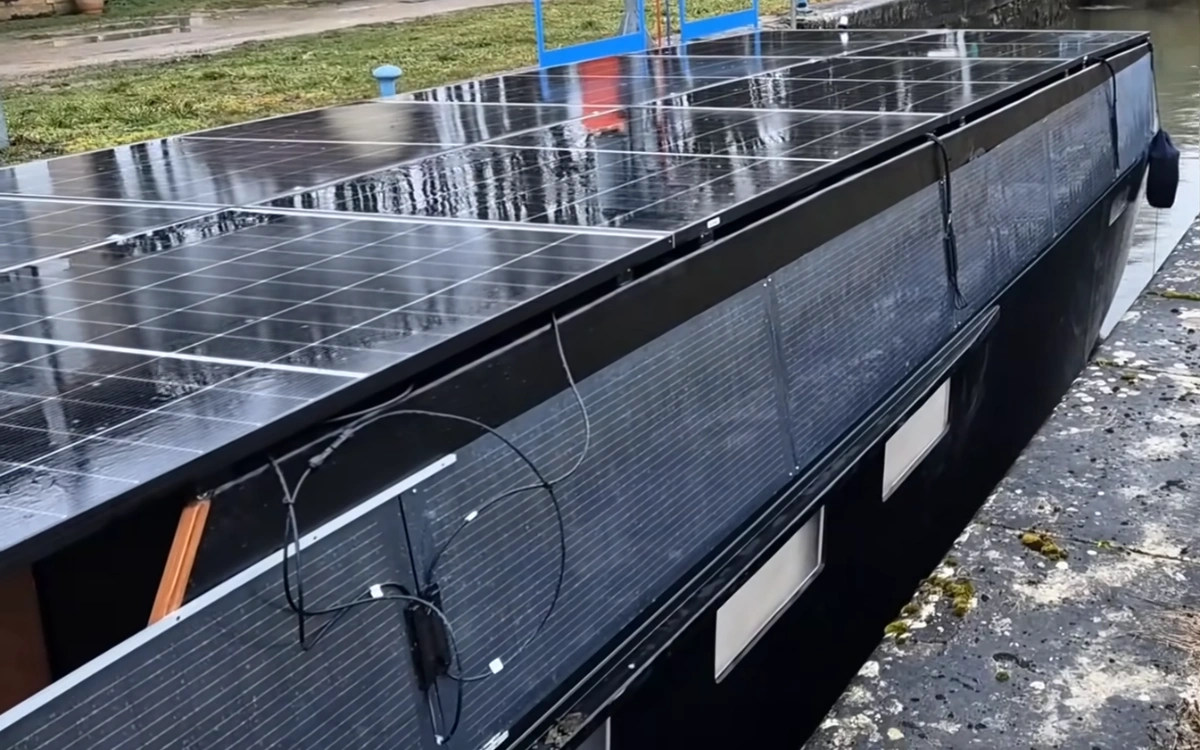
The current layout distributes solar panels across the top deck, the forward section, and both sides of the hull, and adding solar panels to the rear deck or employing foldable arrays on the Helios 11 can push it even further.
An upgraded 8,000W system would support a larger motor and high-draw appliances like an onboard sauna.
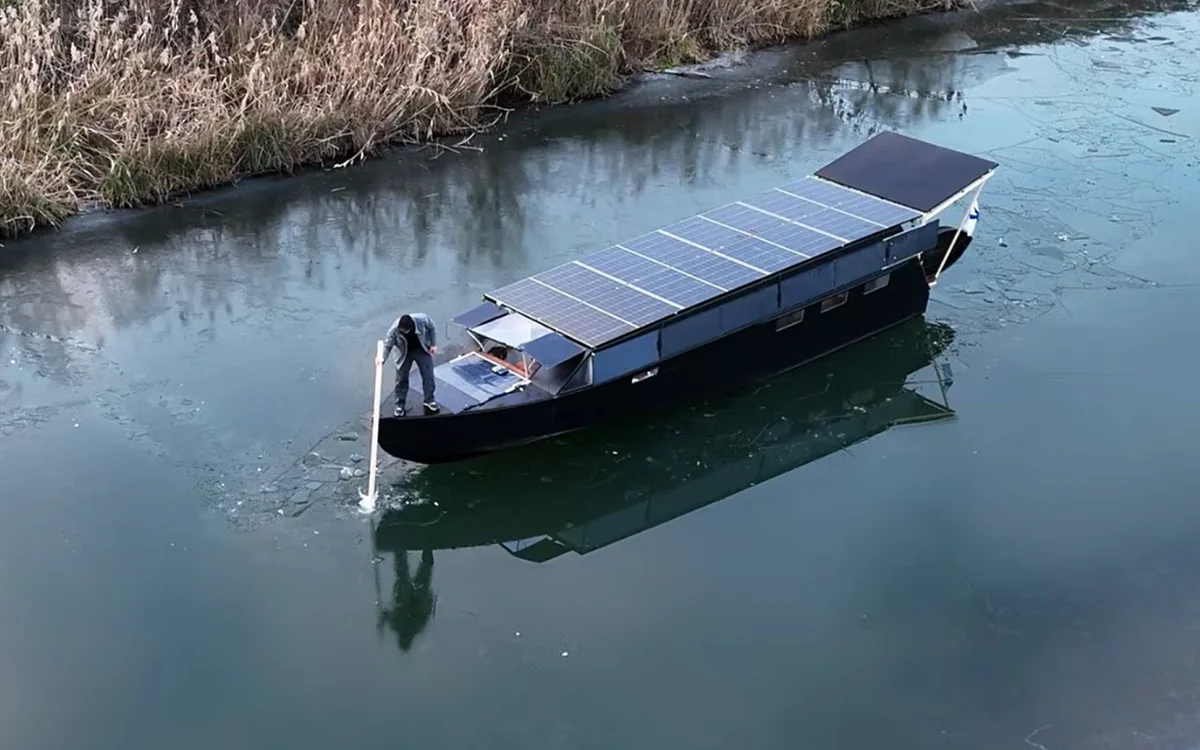
However, excessive solar-powered equipment adds weight that can eventually hinder hydrodynamics.
A lighter 5,000 W version might offer a higher cruise speed in certain scenarios because the boat sits higher in the water.
But most users will find that 6,000 W of solar panels offers the most practical balance for a solar-powered ocean-going lifestyle.
If you’re wondering how this actually works, the general rule is that fully solar-powered journeys rely on a conservative one-third rule for total power generation.
This means a captain can expect to harvest one-third of the total raw solar panel capacity as sustained input.

For the Helios 11, this results in a constant 2,000 W stream for engines and navigation.
Believe it or not, this solar-powered energy level is already faster than many traditional sailing boats during typical day cruising.
In addition, it offers a silent experience that traditional cruise speed methods cannot replicate, and the data collected from the river trials proves that the current setup is more than enough for long-range travel.
Scaling up solar panels for the next generation
Success with the Helios 11 is leading to more ambitious solar-powered designs for professional explorers.
The upcoming Helios 22 Explorer monohull will feature a narrow frame to accommodate a higher density of solar panels.
Total capacity for this solar-powered explorer will reach 28kW of raw energy. Such a high energy ceiling enables a higher cruise speed and improved performance during winter months.
Twin-hull designs offer even more surface area for solar-powered arrays and large solar panels. For instance, a 16-meter power catamaran can carry 72 solar panels for a total of 34.5 kW.
This massive solar-powered output supports a sustained cruise speed of 12 to 16 knots. The catamaran design also provides a square bow, which is ideal for mounting even more solar panels.
These advances ensure that the next generation of solar-powered yachts will cross oceans with high reliability.
Solar-powered yachting is moving from an experimental phase to a viable reality for global maritime travel.
The Helios 11 proves that precise engineering and efficient solar panels can replace internal combustion engines.
As solar panel efficiency increases and hull designs evolve, more vessels will also be able to achieve an infinite range.
So it seems that the future of maritime travel is sustainable, solar-powered solutions that remove the need for fossil fuels entirely.
DISCOVER SBX CARS: The global premium car auction platform powered by Supercar Blondie