AI is cooking up wild physics experiments that push science beyond human limits
Published on Aug 20, 2025 at 10:50 PM (UTC-4)
by Ben Thompson
Last updated on Aug 20, 2025 at 10:50 PM (UTC-4)
Edited by
Emma Matthews
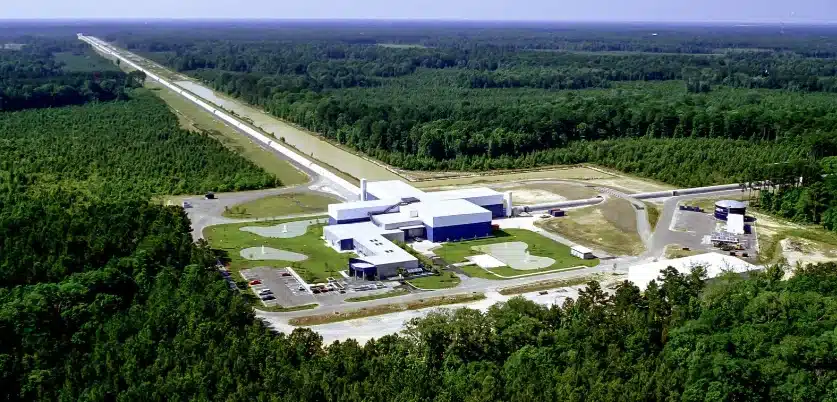

AI is coming up with wild physics experiments that are pushing science beyond human limits.
The Laser Interferometer Gravitational-Wave Observatory (LIGO) is an advanced piece of tech.
It has two gravitational wave detectors in two different states, and it involves a lot of science involving lasers and waves.
And if all of that sounds awfully technical, wait until you hear about the experiments it’s been conducting.
EXPLORE SBX CARS – Supercar auctions starting soon powered by Supercar Blondie
How this AI is pushing the boundaries of science with wild physics experiments
Rana Adhikari, a physicist at the California Institute of Technology, helped develop LIGO back in the mid-2000s.
But even that comes a decade after it began construction – and a decade before it would be finished.
Here’s how it works in a nutshell.
Inside each of the gravitational wave detectors – one based in Washington, one in Louisiana – laser beams bounce back and forth down the four-kilometer arms of a giant L.
Whenever a gravitational wave passes through, the length of one arm changes by less than the width of a proton.
For you non-physicists out there, that’s less than roughly 0.84 femtometers.
Or, a tiny fraction of a millimeter.
While it may seem unimaginably tiny, scientists are able to make new discoveries through this.
Adhikari wanted to see if improving LIGO’s design could enable it to pick up waves on a broader band of frequencies.
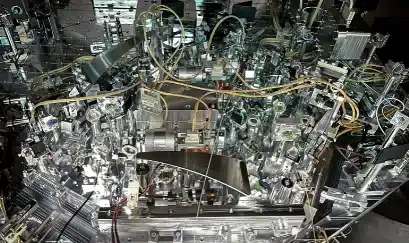
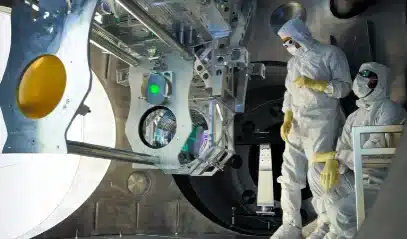
This could help LIGO see merging black holes or make new discoveries.
Basically, things beyond the comprehension of most of us.
But here’s the novice’s summary – AI is being rolled out in physics in ways we never thought possible before.
Related


The future is here…and it’s a lot to take in
Everywhere you look, there’s a story about AI doing something amazing.
One San Francisco startup helps the Cleveland Clinic teach AI to read minds in ICUs, while another is enabling an AI assistant to run a shop.
In fact, AI may be getting a little too good.
Microsoft recently released a study that revealed which 40 jobs are most at risk from AI.
But fear not, it also included the 40 that can’t be replicated yet.
So fingers crossed.
Ben joined Supercar Blondie in February 2025 after being published by international organizations including LADbible, The Sun, the New York Post, and the Daily Mail. He covers supercars, rare and collectible vehicles, aviation, luxury assets, and the fascinating people behind them. His reporting has explored everything from seven-figure supercars and historic Ferrari collections to unusual aircraft adventures and extraordinary automotive discoveries from around the world. Ben has also gained first-hand insight into vehicle craftsmanship and customization, including visiting specialist workshops to see bespoke vehicles up close.




