NASA crashed a spacecraft into an asteroid and accidentally moved the entire solar system it belongs to as well
Published on Mar 13, 2026 at 7:46 AM (UTC-4)
by Daisy Edwards
Last updated on Mar 13, 2026 at 11:53 AM (UTC-4)
Edited by
Amelia Jean Hershman-Jones
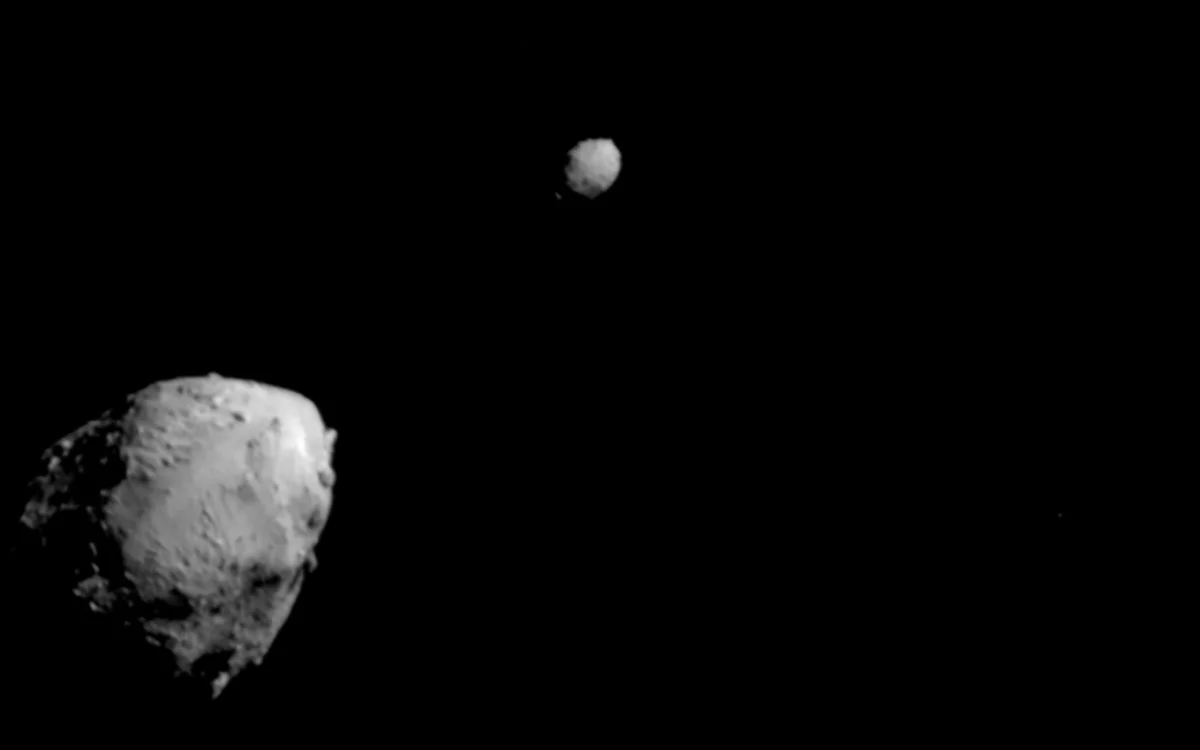

NASA crashed a spacecraft into an asteroid and accidentally moved the entire solar system it belongs to as well, in one of the most unexpected outcomes in recent space exploration.
The agency’s DART mission (Double Asteroid Redirection Test) famously slammed into the asteroid moonlet Dimorphos in September 2022 as a test of planetary defense.
Scientists already knew the collision had successfully changed Dimorphos’ orbit around its parent asteroid Didymos.
But new research shows the impact also slightly altered the motion of the entire asteroid system around the Sun.
Click the star icon next to supercarblondie.com in Google Search to stay ahead of the curve on the latest and greatest supercars, hypercars, and ground-breaking technology
NASA crashed a spacecraft into an asteroid
Normally, when you hear the word ‘crash’, you assume the worst; however, this instance in space was actually planned by NASA.
DART was designed to see whether humanity could push a dangerous space rock off course if one ever threatened Earth.
Dimorphos originally orbited Didymos once every 11 hours and 55 minutes, but after the crash, that orbital period shortened to about 11 hours and 23 minutes.
That result alone was a huge success for the mission and proved the technique could work in real life.

But researchers studying the aftermath found something even more surprising.
The impact also changed the way the Didymos and Dimorphos system travels around the Sun.
The difference is incredibly small, just fractions of a second in its orbital motion, but it marks the first confirmed time humans have altered the solar orbit of a natural celestial object.
The reason comes down to the huge plume of debris blasted off the space rock during the crash.
When the spacecraft hit Dimorphos, it did not simply bounce momentum into the rock.
The impact kicked huge amounts of dust and rubble into space, and that ejecta acted like a rocket exhaust that amplified the force of the collision.

Related
Even a tiny nudge can cause chaos
That extra push ended up nudging the motion of the entire asteroid pair.
While the shift is extremely small, it demonstrates exactly how planetary defense could work in the future.
Even a tiny change in an asteroid’s path can add up over time and prevent a potential impact with Earth decades later.

Didymos and Dimorphos were never a threat to our planet, but the experiment provided the first real-world proof that a kinetic impact mission can move an asteroid in space.
In other words, humanity now knows it can slightly rearrange objects in the Solar System if needed.
And as it turns out, when NASA tried to move one asteroid, it accidentally gave the whole asteroid system a tiny push through space as well.
Daisy is a technology and automotive journalist covering artificial intelligence, consumer tech, Apple news, cryptocurrency, emerging technologies, and transportation innovation. Since joining the team in 2025, she has reported on everything from AI-powered startups and major iOS updates to viral car stories and the latest developments shaping transportation and the digital economy. Drawing on her background in automotive journalism and a degree in History and Journalism from Goldsmiths, University of London, Daisy specializes in breaking down complex topics into clear, engaging reporting for a global audience. Her work spans cutting-edge technology, innovative vehicles, and the people driving change across both industries. Daisy has gained first-hand access to some of the world's most talked-about technologies and innovators, including meeting Tesla's Optimus humanoid robot during its first European appearance in London. She has also discussed the future of space exploration with an astronaut, bringing unique insights and real-world perspectives to her coverage of emerging technology.




