Mind-blowing simulation puts Voyager 1's Earth shattering speed into real world perspective
Published on Feb 26, 2026 at 5:27 AM (UTC+4)
by Alessandro Renesis
Last updated on Feb 25, 2026 at 8:25 PM (UTC+4)
Edited by
Amelia Jean Hershman-Jones

The Voyager 1 satellite is one of the fastest human-made objects, beating anything else made on Earth by a considerable margin – but it’s hard to put that speed into perspective.
It’s also the most distant human-made object from our planet.
At the time of writing, it is traveling through the galaxy around 15 billion miles away from us, moving at a velocity of 38,026.79mph (17.0km/second).
The Airplane Mode YouTube channel has created a simulation of the Voyager 1 satellite’s speed if it were on Earth, and, as you can see from the clip above, it’s scary fast.
DISCOVER SBX CARS: The global premium car auction platform powered by Supercar Blondie
Voyager 1 is nearly 50 years old – and its speed is out of this world
Voyager 1 was launched in 1977, making it one of the oldest active space probes.
The idea was to study the outer Solar System and, so far, it’s been working a treat.
Voyager 1 has already flown by Jupiter and Saturn, and it’s also flown past Saturn’s largest moon, Titan.
NASA isn’t exactly sure how much longer Voyager 1 is going to survive, but they do know that after 2036, the probe will almost certainly be out of range of the Deep Space Network.
In other words, it’ll still be out there, but we probably won’t be able to communicate with it.
Click the star icon next to supercarblondie.com in Google Search to stay ahead of the curve on the latest and greatest supercars, hypercars, and ground-breaking technology
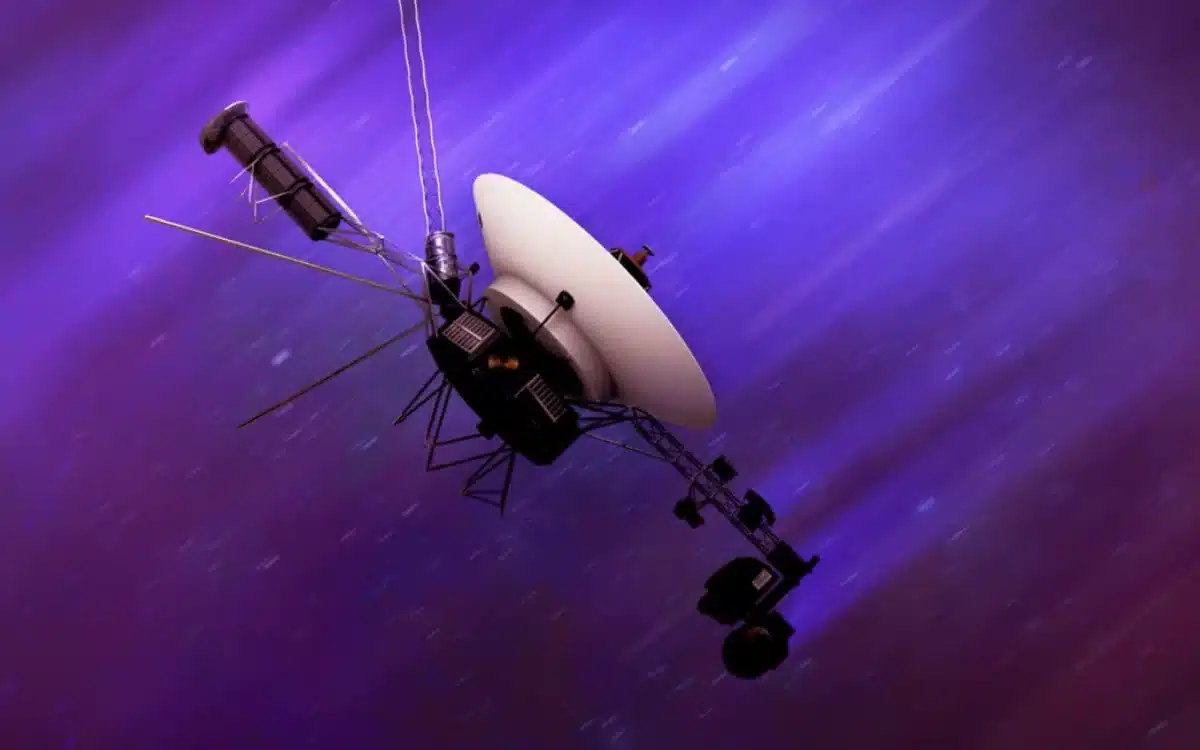
The reason why NASA launched both Voyager 1 and Voyager 2 in the same year
In the 1960s, at the peak of the Space Race, NASA realized that the 1970s would provide a unique opportunity to launch two space probes that could be expected to travel past Jupiter, Saturn, Uranus, and Neptune in ‘one go.’
This phenomenon has a strange name in astronomy.
It’s called Syzygy, and it occurs when three or more celestial bodies are located roughly in a straight-line configuration in a gravitation system.
It was a once-in-a-lifetime opportunity, and NASA seized it by launching two twin space probes.
Interestingly, Voyager 1 was actually launched after Voyager 2, and it traveled much further.
As of February 2026, Voyager 1 is approximately 2.5 billion miles further away from Earth than Voyager 2.
After beginning his automotive writing career at DriveTribe, Alessandro has been with Supercar Blondie since the launch of the website in 2022. In fact, he penned the very first article published on supercarblondie.com. He’s covered subjects from cars to aircraft, watches, and luxury yachts - and even crypto. He can largely be found heading up the site’s new-supercar and SBX coverage and being the first to bring our readers the news that they’re hungry for.