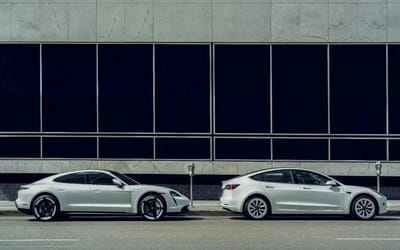
Tesla Model 3 still drives 31 miles after gauge shows zero percent charge
Published on Jan 05, 2026 at 10:30 AM (UTC+4)
by Jason Fan
Last updated on Jan 05, 2026 at 9:47 PM (UTC+4)
Edited by
Kate Bain

Seeing zero charge on the dash usually spells doom, but the Tesla Model 3 just proved that number might not be as final as it looks.
For EV drivers, seeing a big fat zero on the dash usually triggers instant panic, sweaty palms, and frantic charger searches.
But as it turns out, ‘zero’ doesn’t always mean zero if you drive a Tesla.
Thanks to a hidden energy buffer, running out of displayed charge isn’t the instant road trip nightmare many imagine.
SBX CARS – View live supercar auctions powered by Supercar Blondie
The 2026 Tesla Model 3 Premium was operating on FSD
This real-world experiment comes courtesy of Kyle Conner from the Out Of Spec Testing YouTube channel, who decided to test exactly how far a modern EV could go after the battery gauge bottomed out.

The car used in the experiment is a 2026 Tesla Model 3 Premium, which was formerly known as the Long Range rear-wheel-drive model.
Conner took the experiment very seriously.
He preconditioned the battery to optimal temperature, drove on a closed circuit for safety, and reset the trip computer the moment the car hit zero state of charge.
At first, the Tesla behaved pretty normally.
However, when the screen showed zero charge, it still claimed two miles of range remaining.
Once that disappeared and the display hit zero miles, things got interesting.

Instead of shutting down, the Tesla Model 3 just… kept going.
In total, it traveled another 31 miles after the range estimate dropped to zero, using nearly six kilowatt-hours of energy that Tesla had quietly tucked away as a reserve.
That’s a sizable buffer by any standard.
Given that the Model 3 Premium is rated at 363 miles of EPA range, this means the EV has almost 10 percent of charge as a buffer.
During the test, it averaged an outstanding 192.5 watt-hours per mile, or roughly five miles per kWh, highlighting just how efficient Tesla’s drivetrain can be.
Tesla’s Full Self-Driving system was engaged as well, until the car eventually requested driver takeover and gently brought itself to a stop with clear on-screen warnings.

Not every EV will have the same buffer size
To be clear, not every EV will give you 30 bonus miles after hitting zero charge, so best not to rely on this.
Buffer sizes vary by manufacturer, and some are far more conservative.
There are also many factors that affect an EV’s range, like how fast you’re going, or how cold the outside is.
Still, every modern EV includes some reserve energy to prevent sudden shutdowns, and give drivers a fighting chance to reach a charger.
That said, relying on this hidden buffer isn’t a great habit.
Fully draining a battery isn’t ideal for long-term battery health, and planning charging stops is always the smarter move.
But if you ever find yourself staring at zero charge with nowhere to plug in, it’s reassuring to know your EV might have more life left than you think.
DISCOVER SBX CARS: The global premium car auction platform powered by Supercar Blondie