Voyager 1 just said hello to NASA from interstellar space despite being over twenty-five billion kilometers away
Published on Feb 06, 2026 at 11:56 AM (UTC+4)
by Molly Davidson
Last updated on Feb 06, 2026 at 5:31 PM (UTC+4)
Edited by
Mason Jones

Voyager 1 has been drifting through the dark for nearly half a century, long after its original mission wrapped up and its expectations quietly expired.
Now, from more than 25 billion kilometers away, it’s checked in again.
The signal was faint, almost laughably so, but it arrived all the same.
And at this distance, that alone feels like a small miracle.
DISCOVER SBX CARS – The global premium auction platform powered by Supercar Blondie
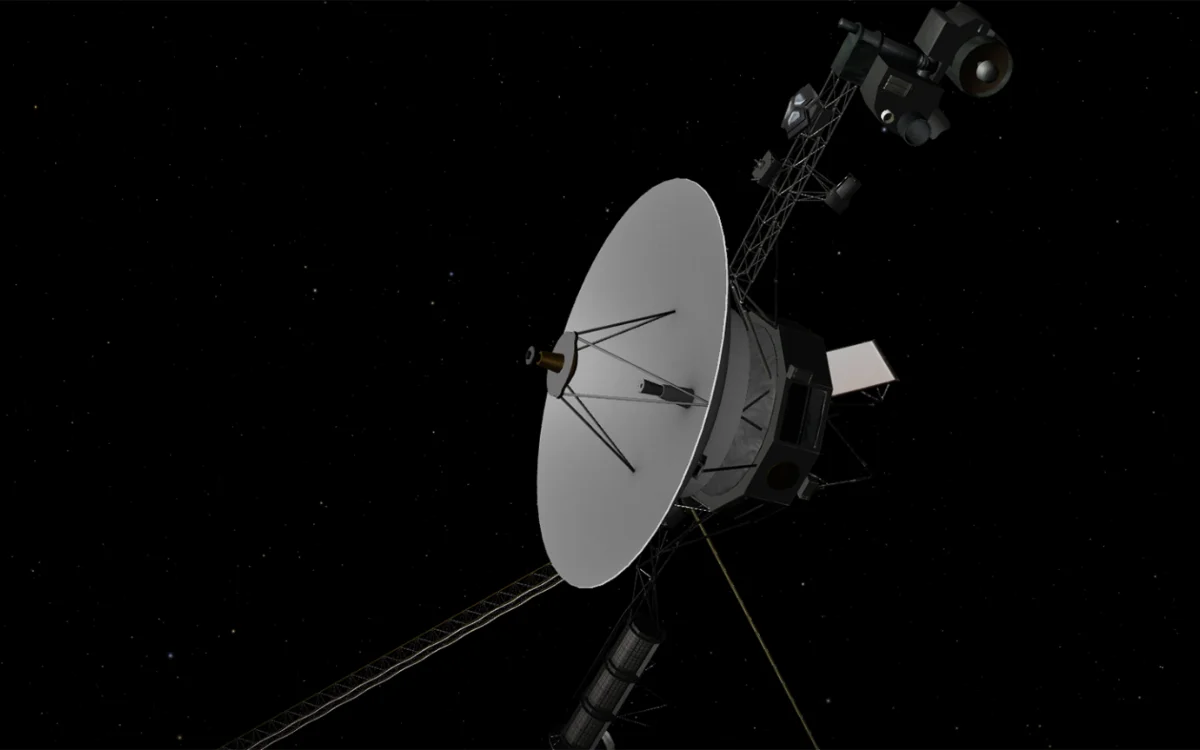
Voyager 1 is still talking to Earth from interstellar space
Launched in 1977, NASA’s Voyager 1 was never meant to last this long.
It flew past Jupiter and Saturn, sent home its postcards, and then just kept going.
In 2012, it officially entered interstellar space, becoming the most distant human-made object ever.
Today, it’s roughly one light-day from Earth, moving at around 61,000km/h through a region no spacecraft had ever reached before.
Voyager 1 just said “hello” to Earth from Interstellar space, about 25.4 billion kms away! 🥹
by u/prasadvikash340 in BeAmazed
On February 2, engineers received another radio signal from Voyager 1.
It wasn’t carrying new science data or dramatic discoveries.
It was simply proof the spacecraft is still alive.
The energy behind that transmission is so weak it’s often compared to less than the impact of a falling snowflake.
Most of Voyager’s instruments have already been shut down to conserve power, leaving only the bare minimum systems running on a slowly fading nuclear energy supply.
The fact that NASA can still hear anything at all is well beyond what the mission’s designers ever planned for.
At this point, communication itself is the achievement.
Click the star icon next to supercarblondie.com in Google Search to stay ahead of the curve on the latest and greatest supercars, hypercars, and ground-breaking technology
When 25 billion kilometers still isn’t very far
After nearly 50 years of nonstop travel, Voyager 1 is about one light-day from Earth, which works out to roughly 25 billion kilometers.
That’s a huge distance by human standards.
But in space, it’s barely anything.
At its current speed of around 61,000km/h, Voyager wouldn’t reach the Andromeda Galaxy for roughly 45 billion years – longer than the universe has existed.
This is why space distances are so hard to picture.
Numbers like light-days and light-years sound impressive, but they don’t translate well to real movement across the universe.
Even the fastest thing humans have ever built is moving incredibly slowly on a cosmic scale.
It’s not a design flaw.
Space is just that big.
DISCOVER SBX CARS: The global premium car auction platform powered by Supercar Blondie
With roles at TEXT Journal, Bowen Street Press, Onya Magazine, and Swine Magazine on her CV, Molly joined Supercar Blondie in June 2025 as a Junior Content Writer. Having experience across copyediting, proofreading, reference checking, and production, she brings accuracy, clarity, and audience focus to her stories spanning automotive, tech, and lifestyle news.