Breathtaking footage shows Japanese maglev train whizzing past at 310mph like a bullet while a crowd looks on stunned
Published on Mar 30, 2026 at 11:25 AM (UTC+4)
by Ben Thompson
Last updated on Mar 30, 2026 at 11:25 AM (UTC+4)
Edited by
Mason Jones
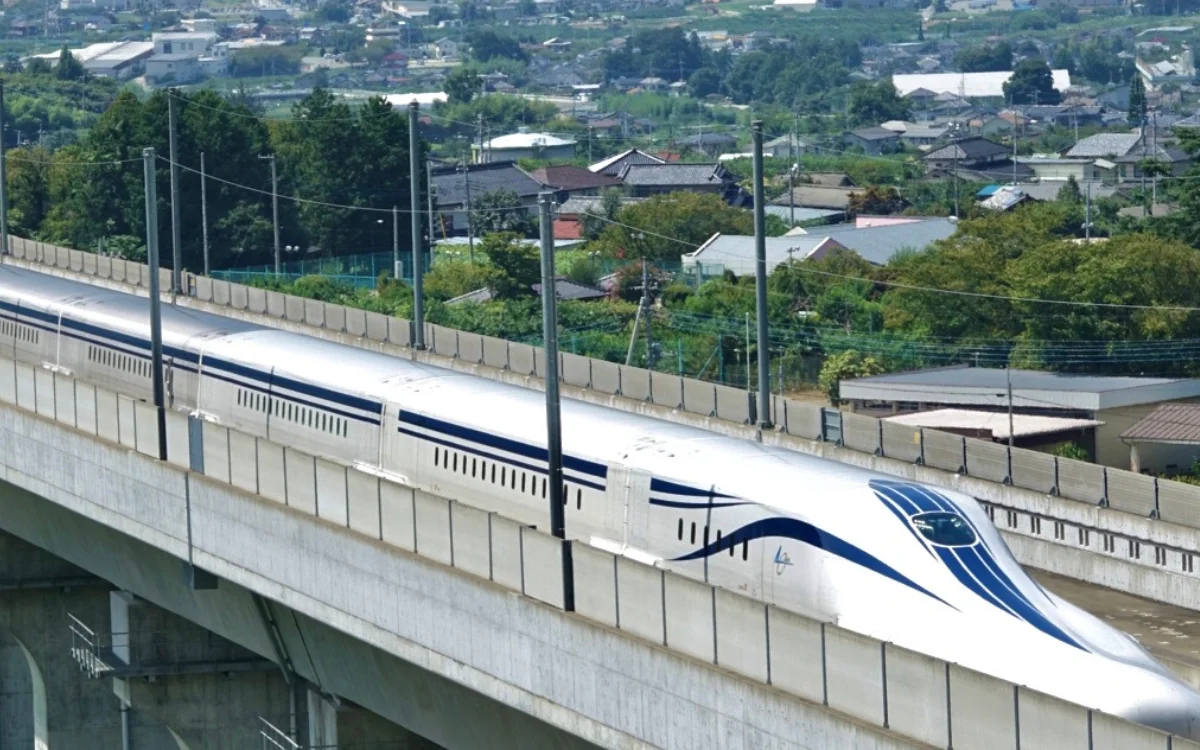

Hold onto your hats, because this footage of a Japanese maglev train whizzing by is enough to make you feel like you’ll get blown away.
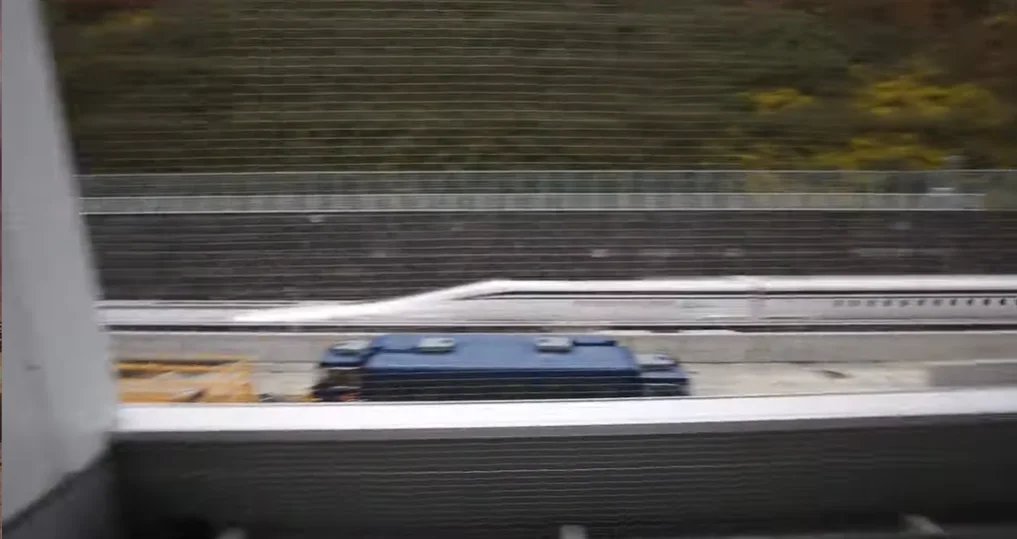
Travelling at 310mph, this was the moment a maglev train zoomed down the Chuo Shinkansen line in the Japanese city of Yamanashi.
It was a breathtaking display, and an exciting look at what’s expected to come.
The question is – when we finally see this line complete?
Enter our competition to win a stunning 2006 Ford GT or $400,000 cash!
What exactly is a maglev train and what’s the big deal?
First of all, let’s define what a maglev train actually is, because it’s very distinct from your standard train which runs on wheels.
This is a system of rail transport where rolling stock is levitated by electormagnets.
As a result, maglev trains have higher top speeds and are capable of faster acceleration.
That’s in addition to lower maintenance costs and lower noises.
Although it’s got the aura of modernity around it, these trains actually owe their origin to a British man born in 1921.
Eric Laithwaite was an electrical engineer known as the ‘Father of Maglev’, having built on the work of German engineer Hermann Kemper.
Back in 1964, Laithwaite developed the world’s first full-size linear induction motor.
Like a traditional motor, it’s made up of moving parts – but when current is applied, the train is propelled.
Rather than converting rotational energy into movement, direct thrust comes from the motor.
With no energy lost from friction, a more efficient and quieter ride is created.
The first maglev line was built in the English city of Birmingham, where a low-speed maglev train connected the city’s train station to its airport, Northeast Maglev reported.
Germany also dabbled in maglev trains between 1984 and 2012.
Only seven maglev trains are operational in the world today – four in China, two in South Korea, and one in Japan.
The ones in China have certainly generated plenty of headlines, from its top speeds of 370mph to breathtaking tests.
But Japan’s efforts are nothing to sneeze at either.

Is it a bird? Is it a plane? No, it’s the Chuo Shinkansen
The Chuo Shinkansen has been in the work for a long time, set to connect Tokyo and Nagoya.
Once complete, it’s estimated that it would cut the current travel time from 90 minutes down to 40.
And that’s not forgetting the Tokyo to Osaka line, which would take shave off 73 minutes of travel time.
The footage shared to YouTube channel noms780 was filmed way back in November 2015.
This was a test track demonstration, and it was mighty impressive.
But as of yet, concrete completion dates for the Chuo Shinkansen prove to be elusive.
The estimated cost has spiraled to ¥11 trillion ($73 billion), with the Nagoya line expected to be completed between 2034 and 2036 – a decade behind previous operation dates of 2027.
The Osaka line is anticipated to follow in 2037, bumped up from previous estimates of 2045.
Whenever it arrives, it’ll be exciting to see this is in action for real.
DISCOVER SBX CARS: The global premium car auction platform powered by Supercar Blondie
Following stints at LadBible, The Sun, The New York Post, and the Daily Mail, Ben joined the team full-time in February 2025. In his role as Senior Content Writer, his sparkling copy, the ability to sniff out a good story at 100 paces, and a GSOH quickly led to him becoming an integral and invaluable member of the writing staff.