Man who broke down in the Sahara desert turned his car into a motorcycle and rode it to safety 12 days later
Published on Feb 22, 2026 at 6:14 PM (UTC+4)
by Callum Tokody
Last updated on Feb 19, 2026 at 9:50 PM (UTC+4)
Edited by
Emma Matthews

A motorcycle built from a Citroën 2CV became the only viable way out of the Sahara Desert after a breakdown in 1993.
The car failed far from towns, paved roads, or regular traffic.
Walking back was possible in theory, but supplies were limited, and the heat was constant.
So, using the remains of the Citroën 2CV offered the best – and most practical – option.
VISIT SBX CARS – View live supercar auctions powered by Supercar Blondie
The breakdown in the Sahara Desert
In March 1993, Émile Leray left Tan-Tan in southern Morocco and headed toward Zagora.
The route crossed long sections of the Sahara Desert and passed through areas monitored by military checkpoints.
Leray carried 10 days of food and water, along with a toolbox, in his Citroën 2CV.
But near the village of Tilemsen, soldiers at a checkpoint instructed him to turn back.
Leray initially followed the order before leaving the road and continuing across the open desert.
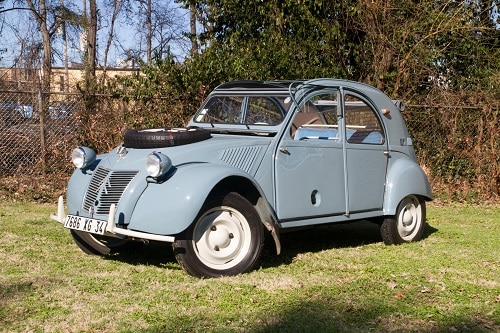
The Citroën 2CV managed the terrain for a short distance before striking a rock.
The impact damaged the front axle and bent the chassis – one front wheel collapsed, and the suspension arm folded.
His Citroën 2CV could no longer be driven. To his horror, Leray was left around 20 miles from the nearest settlement in the Sahara Desert.
With no immediate help expected, he assessed what still worked.
The engine and gearbox remained functional. Two wheels were usable.
The illegal lifesaving motorcycle
Leray began dismantling the Citroën 2CV using the tools he had.
During the day, the removed body panels provided shade.
At night, he cut the chassis down and repositioned the engine closer to the center.
Over time, the car took on the shape of a motorcycle.
The seat came from a section of the rear bumper.
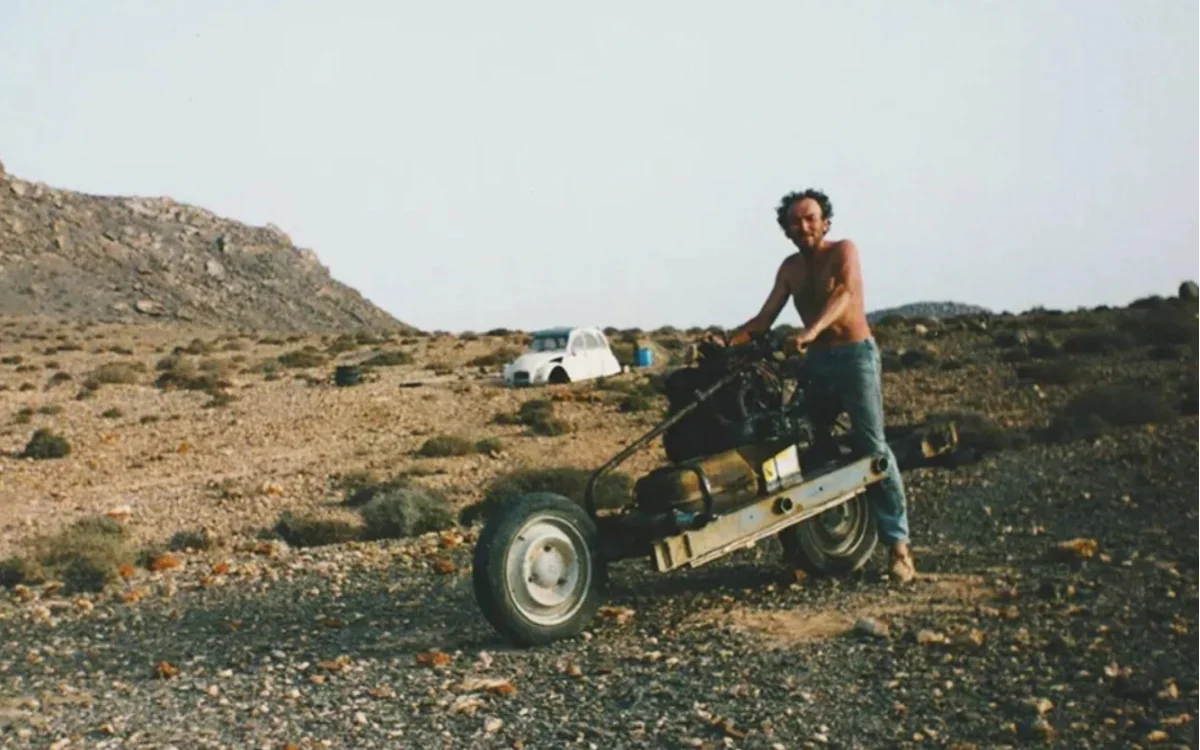
Handlebars were assembled from spare parts. A simple switch replaced the original ignition.
The license plate from the Citroën 2CV was mounted at the rear of the motorcycle.
In total, the work took 12 days and 11 nights, and his water supplies ran low by the end of the process.
But once he’d finished, the motorcycle ran under its own power, though balance was difficult on sand and rock.
Leray fell several times while riding across the Sahara Desert, but continued moving, and eventually, his DIY motorcycle carried him back toward Tan-Tan at low speed.
But then he caught the attention of military personnel who followed him.
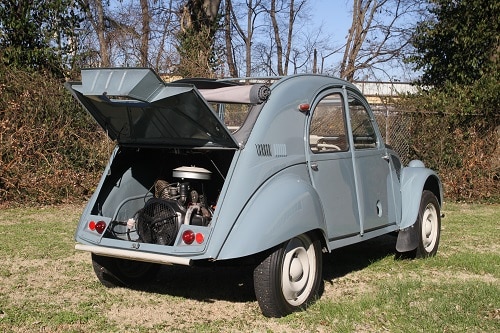
To verify his account of the last couple of weeks, they escorted him back to the remains of the Citroën 2CV before accompanying him into town.
Leray was fined because the motorcycle no longer matched the Citroën 2CV registration documents he had used when entering Morocco.
He was fined approximately €450, around $533, for the offense.
The motorcycle remained in Morocco, and Leray returned to France, but later came back in another Citroën 2CV to retrieve his original vehicle – or what was left of it.
Today, the motorcycle stands as a record of a practical response to a breakdown in the Sahara Desert, shaped by available parts and the need to keep moving.
And the mechanical knowledge to make it happen.
DISCOVER SBX CARS: The global premium car auction platform powered by Supercar Blondie