Newly published Ferrari patent could end up reinventing the piston engine as we know it
Published on Dec 09, 2025 at 9:41 AM (UTC+4)
by Jason Fan
Last updated on Dec 09, 2025 at 9:43 PM (UTC+4)
Edited by
Kate Bain

In an industry that rarely questions the fundamentals, a new Ferrari patent is making waves by daring to rethink the very DNA of the piston engine.
While supercars often grab headlines for wild horsepower numbers or screaming redlines, this idea goes much deeper: right to the basic shape of the pistons themselves.
Instead of chasing more power through turbos or electrification, Ferrari is challenging one of the most fundamental assumptions in engine design.
And if it ever reaches production, it could change how high-performance engines are built going forward.
SBX CARS – View live supercar auctions powered by Supercar Blondie
Why this Ferrari patent is such a big deal
To understand why this matters, it helps to step back and look at how piston engines came to be.
Since the birth of internal combustion, engines have relied on round pistons sliding up and down round cylinders.
That wasn’t because circles were perfect for combustion, but because they were the easiest shapes to make at the time.
Early machine tools were simple, and round pistons machined on lathes were cheap, strong, and reliable.
Even as materials and tolerances improved, the basic geometry stayed the same.
The new Ferrari patent challenges that long-held tradition by proposing oval, or more accurately, ‘stadium-shaped’ pistons.
According to the filing, these pistons are oriented with their long sides perpendicular to the crankshaft, a crucial difference from earlier oval-piston experiments like Honda’s legendary NR500 race bike of the late 1970s.
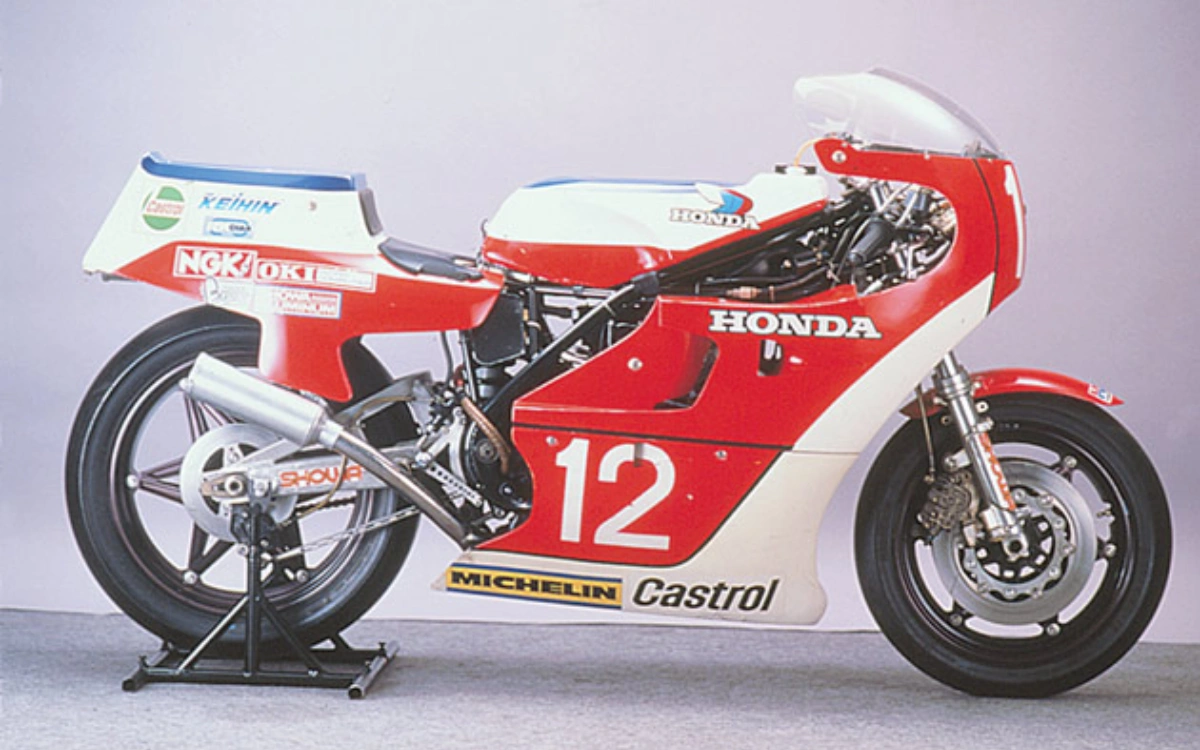
In Honda’s case, the long axis of the piston ran parallel to the crankshaft; Ferrari flips that idea entirely.
This orientation is where things get interesting.
By running the shorter dimension of the oval pistons parallel to the crankshaft, Ferrari can shorten the overall length of the engine.
That’s a big deal, especially for engines with high cylinder counts like V-12s, which the patent illustrations strongly suggest.
Shorter engines are lighter, stiffer, easier to package, and open up new possibilities for vehicle design, which is something Ferrari obsesses over.
The patent also describes paired, coplanar connecting rods linking two opposing pistons to a single crank journal, further shrinking the engine’s footprint.
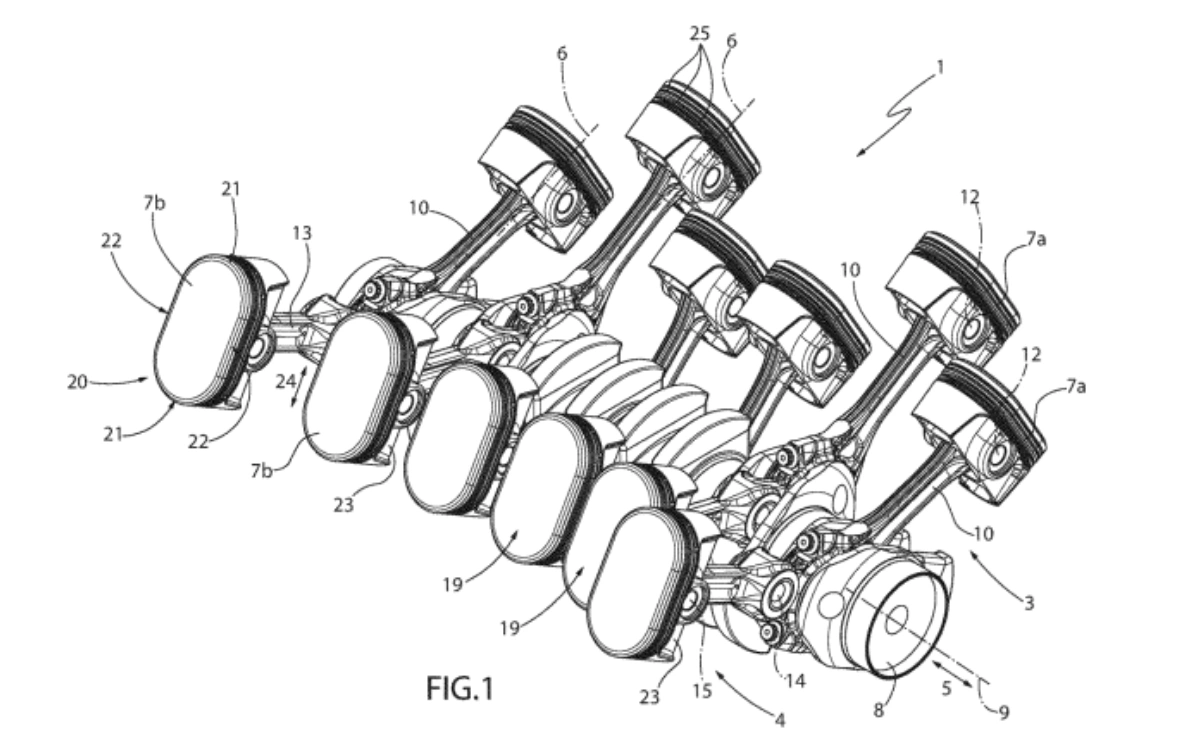
The new patent indicates ICE cars are still relevant
Together, these ideas point to a more compact, efficient, and potentially higher-performing piston engine.
This is done without abandoning combustion altogether.
Of course, patents don’t guarantee production.
Automakers often lock down bold ideas simply to protect future options.
Still, the fact that Ferrari is investing serious engineering effort into rethinking piston geometry shows the combustion engine still has room to evolve.
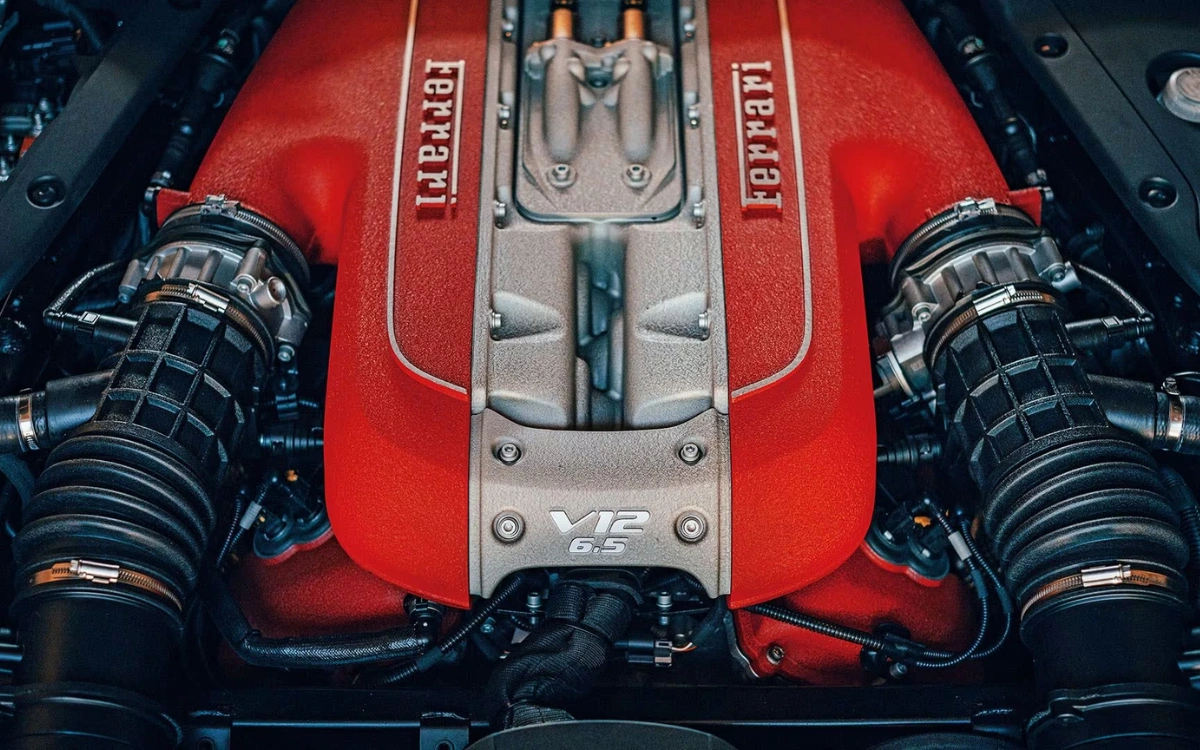
While the world is eagerly awaiting the carmaker’s latest EV, the Ferrari Elettrica, the patent shows that ICE cars still have a place in the company’s plans.
DISCOVER SBX CARS: The global premium car auction platform powered by Supercar Blondie