How the humble Toyota Sera economy car inspired the McLaren F1
Published on Jan 02, 2026 at 3:15 AM (UTC+4)
by Molly Davidson
Last updated on Jan 02, 2026 at 5:15 PM (UTC+4)
Edited by
Kate Bain

Toyota once built the Sera, a small, affordable coupe that looked like it had wandered off a motor show stand and into a dealership by mistake.
It wasn’t fast, it wasn’t expensive, and it definitely wasn’t meant to sit anywhere near the supercar conversation.
But it did one thing so boldly that people still stop and stare at it decades later.
And somehow, that same idea would end up influencing one of the greatest cars ever made.
DISCOVER SBX CARS – The global premium auction platform powered by Supercar Blondie
How the Toyota Sera helped shape the McLaren F1
The car was the Toyota Sera, a small coupe Toyota sold in Japan starting in 1990.
Underneath, it was pretty standard.
It shared parts with the Toyota Starlet and used a 1.5-liter engine making a little over 100 horsepower.
Not slow, but definitely not thrilling.
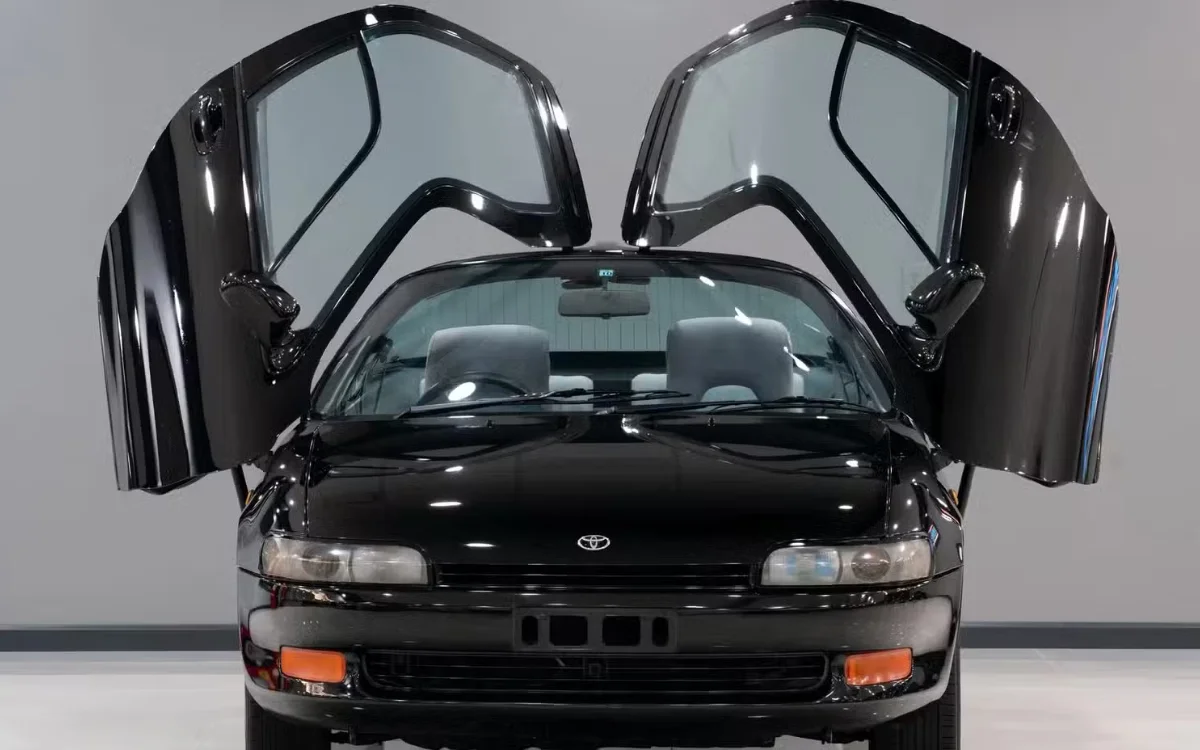
Then there were the doors.
Instead of opening sideways like every other cheap coupe, the Sera’s doors lifted up and forward in a butterfly-style motion.
It looked like something you’d expect on a supercar, not a budget runabout.
But Toyota didn’t do it just for show.
The doors were designed to be light, simple, and easy to use in tight parking spaces.
That clever solution caught the eye of Gordon Murray.
While working on the McLaren F1, Murray studied the Sera’s door setup and later admitted it influenced his thinking.
He wasn’t copying the look, he was learning from how Toyota made something unusual work in the real world.
So while the McLaren F1’s doors are far more complex and dramatic, one of the most famous supercars ever built borrowed a lesson from a humble Toyota.
Toyota’s short phase of doing bold, slightly weird things
The Sera came from a moment when Toyota was all about the fun.
Along with the doors, the car had a massive glass canopy.
The windshield flowed into the roof and rear hatch, making the cabin feel like a fishbowl on wheels.
It looked futuristic, felt airy, and stayed practical.


The Sera was never sold globally and quietly disappeared by the mid-1990s.
Toyota moved on to safer designs that appealed to more people, more reliably.
Cars like the Sera didn’t really fit that plan.
But today, the Sera has become a cult favorite.
It’s import-legal in many countries, prices are climbing, and people are finally realizing how special it was.
Not because it was fast.
Not because it won races.
But because it dared to be different.
The Toyota Sera didn’t set out to inspire a supercar; it just tried something new.
And sometimes, that’s all it takes to leave a mark on automotive history.
DISCOVER SBX CARS: The global premium car auction platform powered by Supercar Blondie
With roles at TEXT Journal, Bowen Street Press, Onya Magazine, and Swine Magazine on her CV, Molly joined Supercar Blondie in June 2025 as a Junior Content Writer. Having experience across copyediting, proofreading, reference checking, and production, she brings accuracy, clarity, and audience focus to her stories spanning automotive, tech, and lifestyle news.